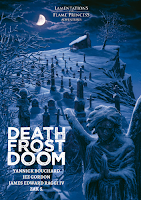
Today's post is really just a way for me to get down in writing what I'd like to focus on in gaming for the rest of the year. My regular Basic Fantasy campaign is winding down. We were going to end it last session, but we needed to cut it short due to time, leaving the PCs halfway through Death Frost Doom. We were supposed to finish it off today, but real life got in the way. In any case, we only have one more session left which means I'll more time to try out a lot more games and put energy into other projects.
First up, I'm working on polishing my notes for the city of Slateholm and submitting it to the Basic Fantasy Workshop. These were all the loose pages of scribbled notes and random tables I used for that portion of my campaign. My players only touched a very small part of it for the couple of sessions they were there and I think there's enough good stuff there to be useful to someone running Morgansfort. My intent with this isn't for these notes and tables to become their own module, but more just in the spirit of sharing what I put together.
Next, I've been slowly working on a draft of an adventure for Basic Fantasy. My idea is pretty large, and I'd like to playtest it before submitting it to the Workshop. At the core is a neat little dungeon idea surrounded by a mini-hex crawl. I think there's a lot of potential for it. I don't think I'll have a draft by the end of the year like I'd hoped, but if I can get the central dungeon written and tested along with the nearby town and surrounds, that will be good.
I'm also chipping away at fleshing out the one-page dungeon I submitted to the One-Page Dungeon Contest last year (I was one of the many runner-up winners). I think I tried to pack too much into the one-page concept and there was a lot of vague details left for the GM to fill in. I was initially going to write this for an OD&D-type system, but tonally it doesn't quite fit (perhaps Swords & Wizardry). There's some body-horror elements that are actually more of a fit for a Lamentations of the Flame Princess or Dungeon Crawl Classics adventure. I'm less comfortable with those systems, however, so we'll see what I think once it's written. I think if I just pitch it to a Basic-style game, I'll be in the ball park, at least.
Speaking of OD&D, I have a hankering for writing a couple of small scenarios for either or both Iron Falcon and Delving Deeper. S&W is pretty well-supported with adventures, but IF and DD each have their own flavor of the early game which I think is worth supporting. All of these adventures will need to be played through too, so I plan my gaming for the next several months to be running various versions of OD&D.
A side benefit to running all this 0e will be that it will help me to really figure out what I like or don't like for my own 0e system I'm putting together. I know that the last thing the RPG community needs is another OD&D clone, but it's really just a way to put my own house rules together in a format to share with players. I'll probably put it up on Lulu for free digitally and a print version at cost, but the main purpose won't be commercially-driven.
I've also, strangely enough, been looking at 5e. One of my players in my local group wants to run a campaign and I'm curious to get a feel for the system that everyone is playing. I've taken a good look at the free Basic Rules, and while I think there is some good things about it, I'm not quite sold on it. There are some things that I still have hard time with. I'd like to give it a fair shake though.
And because I can't leave well enough alone, I've started putting together, not just one, but two different set of hack rules for 5e based on the SRD. In other words, 5e if I had written it. It's a little bit of an experiment. How much can I take out and still stay true to the rules or the spirit of the rules. Can I make a version of the game I'd want to play, but still use the same engine to be 5e-compatible? It's my way of getting under the hood and learning the system as well.
All this for 2019 and I'd still like to play a little Call of Cthulhu and Empire of the Petal Throne as well. I suppose it's better to be busy than bored.
Sunday, April 14, 2019

Saturday, March 23, 2019
GM Notes - Morgansfort Session 12

We last left our party across the street from a tenement
building in a Ravenstone neighborhood where a cultist they were following had
just entered. After a minute of discussion, the group stakes out in an alley
while Pater crosses the road and enters the apartment building. Pater hears a
voice from the door on the right. It’s a man gruffly speaking in a tone of
command. The door begins to open and Pater ducks back into the shadows under
the stairs. The cultist exits followed by a chain of very pregnant women. Pater
dives and backstabs the cultist who falls under the lethal strike of his blade.
The women, dressed in rags and bound together at the
wrists, are shocked, but looked somewhat numb to the violence. Pater asks who
they are. A young, dark-haired woman says they are known as The Mothers. They
are slaves whose lives are dedicated to breeding slave stock. The unfortunate
brother was collecting them to bring them back to the pits from their physician
visit. Pater brings them outside and across the street where their bonds are
cut. Pater goes back inside to hide the body inside the apartment. He gets the
body back inside, but leaves quickly when he hears a voice from the back room
ask, “Br. Woodward, is that you,” identifying him as the son of the widow from
the night before.
Two men come out of the building just as Pater makes it
to the alley after having discovered Woodward. The noon bell tolls and the
streets begin filling with townspeople making their way to the chapel. The
group find a (for now) empty house where they hole up while they decide what to
do next. The household is a middle-class home unremarkable except for the
oil-painted picture of the demon lord, Shah Gzerohn, in multiple rooms. The
townspeople are apparently true believers. Nyphus and Mel head to the chapel
while Pater and Renic head northeast towards the industrial warehouse section
of town. They find an abandoned storeroom on the edge of town.
Pater leaves Renic in charge of the Mothers while he
leaves to watch the chapel. He meets two men on the street on his way there.
Renic leaves the Mothers alone to keep from being left on guard duty. Nyphus
and Mel make their way in to the chapel from near back of a long line. The
middle of the chapel contains a giant green crystal coming up from the floor. Both make their way
downstairs to the sacristy where a line of worshippers are entering a portal
through the crystal. Nyphus enters the portal, Mel does not until later under
pressure from the evil brotherhood after she tries to make her way down into
the slave pits. They find themselves in front of a giant stronghold on an
enormous cloud bank over Ravenstone.
They are given an audience with Archbishop Nemesine in a
throne room full of Ravenstone worshippers/townspeople. In the gallery leading
to the throne room are large oil works depicting brutal scenes of worship of
Shah Gzerohn as well as Nemesine’s personal history. At the end are recent
works of the party themselves, saving the early barbarian tribe from the mural
in the dungeon of the Island Fortress. Nemesine is a Sidhe, a faerie being from
another world. He and his lover are exiles from their home world and were cursed
by clerics of Tah shortly after their arrival in this one. He cannot walk the
earth in his true form and may not leave this one for another. Here on the
cloud demi-plane he at least may cover his hideous new form, a mass of writhing
maggots. His lover, similarly disfigured, committed suicide.
Nemesine fails to Geas both Nyphus and Mel. Instead he
offers them a deal. He seeks the Miter of Tah which was stolen by the Duvan’Ku,
the original worshippers of Shah Gzerohn before the barbarians. The cult was
vanquished 700 years ago in their last shrine in the Demonfrost Mountains on a
peak called Deathfrost by a group of Tah’s disciples attempting to take back
the magical Miter. The clerics never returned, but the cult was also never seen
again. It is said Deathfrost’s shrine is filled with gold and ancient artifacts
of wonder. Nemesine’s acolytes cannot climb the peak. Their green marks begin
to burn and their minds fray approaching the peak. The Miter will let Nemesine remove
his curse and leave this plane for good. If the party returns with the item,
Nemesine vows to let the freed Mothers go, disband the Green Mark, put an end to
the slave pits of Ravenstone, and leave this plane. Mel draws up a contract between
them, sealed with the mark of Persephone and Demeter.
In the meantime, Renic leaves the Mothers in their warehouse
hideout for the chapel. Pater sees him approach from his hiding place. Renic
quickly escalates into a conflict with the acolytes and chops one in two. The
fight flushes out Pater as well. They are pursued by cultists, eventually lose
them, and meet back at the warehouse. Nyphus and Mel return later with the
terms of their agreement, planning to return back to the chapel the next morning.
Sunday, January 27, 2019
Dungeon Digressions: Rooms Apart and Other Ways Out

(Warning: some SPOILERS follow for G1, Stonehell, and the
House of Coldarius adventures)
I’ve been formulating an idea of a particular type of
dungeon room with which I’ve recently become enamored. For lack of a better
term I’ll call them dungeon digressions. These rooms are not only set apart
from the general theme of everything else going on around them, but more
importantly hint at a larger “otherness” beyond the understood edges of the
adventure, or even campaign.
I’ll give you an example which crystalized this concept
for me when I recently re-read G1 Steading of the Hill Giant Chief. The room is
17A of the dungeon level, the Weird Abandoned Temple. The orcs on this level
(presumably those rebelling against their giant masters) have blocked the door
to this temple with rocks, and it is bolted shut. Whether it’s an attempt to
keep people out or keep something else in is precisely what makes it so inviting
for curious adventurers. Inside the temple the stonework glows purplish-green.
The walls chill to the touch and the columns induce nausea. Carved signs and
shapes seem to stare at intruders and shift position when not watched. A
greasy, yellow-gray altar sits at the far end and beyond it a concave alcove. Staring
into the alcove causes visions of sickly mauve and violet tendrils to writhe
and stretch towards the viewer, causing insanity 50% of the time. If the viewer
doesn’t go insane, they are gifted a scarab of insanity or a 5,000 g.p. gem.
This is a great eerie room heavy on the eldritch vibe,
but it’s the room’s context within the rest of the adventure that makes it
stand out. This room shows up in the middle of a 9th-level
recon/hack-and-slash stronghold invasion with enslaved orcs revolting against
giants working for the Drow. There’s a lot going on in this module already,
with breadcrumbs, subplots, and portals to the next chain of adventurers in the
G-D-Q series. So why did Gary stick 17A (and 18, the blocked-off Vestry sloping
downward) into this adventure? Was it a hint or a connection to a cult of evil
chaos, or elemental evil? Or does the vision of the alcove with its
Lovecraftian feel hint at a Tharizdun connection?
Whatever the intention, the impact is great. No matter
how massive and intricate Lolth’s grand designs are in this campaign, this one
little room gives a hint of a massive, incomprehensible reality which dwarfs
the demonweb queen’s machinations making them seem petty and small by comparison.
It’s a small portal, a tiny digression, which drops off a deep end into a
larger, abyssal perspective. I love it.
Michael Curtis’ Cenotaph room in the canyon of Stonehell
is a very brief version of this with the room’s bas relief intimating the knowledge
of a vast sleeping entity lying in wait in a distant land. With that kind of
realization, what does it matter if you are downed by a pack of filthy kobolds
in some forgotten corner of an underground prison complex. The scale of the
PCs’ mortal lives have no meaning by comparison. It does a lot without really
doing very much of anything, preparing the PCs for the discovery of the
nixthisis at the heart of the underground hell.
The main interest for me with these side-rooms isn’t that they bring a whiff of R’lyeh to the game. The eldritch
quality of both is merely coincidental. What’s great about them is
they offer a door to worlds older than the mountains in their current
dimension. In short, they can be a hook or way out of the current adventure
into something deeper and weirder. If they want it, that is. In the case of
G1’s 17A, the PCs can decide that what lay beyond the bronze-banded door was
interesting enough to abandon Geoff, clear out the rumble in the Vestry, and
find their way down to the veins of the earth, so to speak.
One more example I recently came across is in the Basic
Fantasy adventure, “House of Coldarius,” from BF3 Strongholds of Sorcery. The
adventure largely concerns a vampire kidnapping a wizard pupil to create a
dark, intelligent sword. It’s a fun, beat-the-clock rescue in a scary house
with various Universal movie monster stand-ins (there’s a vampire, a flesh
golem, a mummy, a lycanthrope, etc.). However, in the locked parlor of room 39
on level 7, there’s a black metal arch with silver runes that serves as a
gateway to the world of the Moonmist Moor, a Bronze Age realm haunted by
spectres who feed off the few humans at night and are kept at bay by huge
monoliths called Spires. It’s only a thumbnail sketch of a world, but the strange
open possibilities of it, the offer to the party to go “elsewhere” is
everything that fantasy should be about.
These kinds of side-door encounters aren’t exclusive to
D&D. They can be found all over the fantasy genre. “Riddles in the Dark,”
from The Hobbit, is maybe the most famous example. Bilbo gets separated from
his party, meets a weird creature, finds a magic ring, and the fate of all
Middle Earth changes. Without that digression and resulting alternate way out
(literally), you don’t get The Lord of the Rings.
A lot of times the campaigns we create are built around a
central, preconceived narrative idea that everything rests on. But these little
“dungeon digressions” are important to have in the game as release valves or
rifts to other worlds or adventures to keep things unexpected and fresh. What
might start as a typical dungeon delve turns into doorway to Barsoom. The heist
of a rare piece of art becomes a portal to the Blue Medusa’s maze. A mirror
becomes a way into Voivodja. An escape from the city watch through a garden
gate leads to a trek into Ynn. A passage through Ultan’s door takes you to the
dream world of Zyan, with its masks and puppet masters. Basically, don’t be
afraid to Terry-Gilliam your D&D game.
Saturday, January 12, 2019
GM Notes - Morgansfort Session 11

After Nyphus lays down a challenge to the black-cloaked
cultists, he starts to cross the street towards them when he hears the whistle
of the city guard. He stops in his tracks and waits for the guard to reach him.
At the same time, the cultists also begin walking toward Nyphus. The parade,
and attending onlookers, remain watchful to see how the drama plays out. Pater,
Mel, and Renic blend in to the crowd and watch to see what happens to Nyphus.
The guards approach Nyphus and the cultists and demand to
know what’s going on. Nyphus accuses the cultists of evil acts at Morgansfort,
and the cultists expose Nyphus and his party as the wanted murderers of members
of their order. Things become heated when Jochim, led by the boy from his
office the day before, suddenly steps in and advocates on Nyphus’ behalf. With
the duties master involved, the guards decide this squabble is above their pay
grade and announce that they will bring both parties before the Duke to settle
the matter.
A march to the palace follows with guards between the
cultist and Nyphus, Jochim, and the boy. Pater, Mel, and Renic all follow separately
at a distance. As the group moves into the merchant quarter on the way to the
Noble quarter a carriage with the initials, MR, passes them, seemingly on its
to the palace too. The procession enters the palace gates, but the rest wait
outside before deciding to regroup back at the ship.
Upon entering the throne room, the Duke is seen finishing
up some business with a group of elegantly garbed elvish diplomats from
Avenrho. It is their ship docked at the wharf next to the Amber Tide and the
Tarred Goose. The Duke tiredly asks the guard what this is about. After a brief
synopsis of the situation, Nyphus lays out his case passionately. The cultists
lay out theirs. During their testimonies two people enter on the side of the
throne room, an elderly gentleman in a wheel chair and his much-younger caretaker,
a raven-haired woman with cruel eyes. This is Baron Morgan Rathwynn, father of
Halden. He recounts the accusations of murder delivered to him by the Bailiff
and Father Thelbain. The boy, Caleb, tells Jochim he saw the Baron’s caretaker
with a green mark tattoo on her chest while she was undressed. The Duke, not
wanting to get involved in a religious dispute, takes each party into his
private quarters for an interview. He meets with Nyphus and Jochim last. He
tells Nyphus to slip away as early as he can the following morning once the
ships are allowed to disembark.
The group go back to the Goose and ask them to leave as
early as possible. They gather their stuff from the wagon. They give Jochim the
wagon for his trouble. Nyphus thanks the boy and they all leave early the next
day. The party and the ship’s crew get on well. Much drunken cavorting occurs.
On the third night of what is to be a two -week voyage,
Nyphus has a dream. He finds himself in a long stone hallway. At the end are
two fountains. An eerie music plays. To the left is a milky fog of star lights,
beyond which is an altar. On the altar, beside two golden goblets and a large
book is a miter. Nyphus wakes with a start. The boat rocks restlessly and the
crew can be heard up on deck. Nyphus goes on deck as does the rest of the party.
Four large Rocs are circling overhead, but do not attack. The crew are alarmed
by the great creatures’ passivity and spooked by the strange omen. The next day
they Ravenstone is sighted off the starboard bow – a week and a half early.
The Goose’s crew quietly unload their cargo and take off,
glad to rid of the strange southerners. The party find accommodations at a
tavern/inn near the docks. Mel offers blessings to the fellow clientele in an
attempt to strike up conversation and learn any news about town. She meets a
middle-aged woman named Mrs. Harrelson, a widow who is proud of her son, a
recent acolyte to the Green Mark, Brother Woodward. The widow talks of the cult
in an adoring voice, awed that her son was part of such a holy group,
reiterating the phrase, “The Green Mark will open the hearts of men.” She
mentions that she hasn’t been able to see much of her son since his vows. Mel
offers to dictate a letter to him and deliver it on her behalf. The widow
graciously accepts and pays Mel for the service. There is a casual reference to
slave pit, but beyond nothing seems too out of the ordinary.
The next day, the group heads out in the direction of the
chapel of the Green Mark which is said to be at the heart of town, all roads leading
to it. The morning streets are gloomy, due to the bank of clouds that hang over
the city. The weather is brisk, but not yet cold, due to the humidity. No one
appears on the streets which, although clean, are packed with ugly,
three-story, shingle-sided tenements.
They reach the chapel, a small, squat and windowless
building on its own at the center of a five-pointed intersection. Before
approaching, they see a cultist leave the building and furtively move down the
street opposite. The group decide to follow him, stopping when he enters a
tenement. They wait and decide what to do next.
Thursday, January 3, 2019
Ability Mods and Hot-Rods: The Dangers of Mixing Basic and Advanced D&D

Before I dive into an analysis of the modifiers
themselves and why I think the Basic-AD&D hybrid is such a volatile combination,
let me first give a little contextual autobiography. This is something I think
I’ve covered in a past post, but it’s worth repeating here since it’s relevant.
I started playing Mentzer Basic (Red Box) in about ’84 or ’85. My friends and I
played “Basic” for a year or two before bowing to the older kids’ wisdom that
“Basic (was) for babies” and moved to AD&D. When I say we played AD&D,
I mean we borrowed what we liked from the Advanced game and used it in our
Basic campaign. AD&D tournament-legal, we were not. At the time I felt
guilty and conflicted about it, like we were cheating, not playing by the
actual rules because AD&D had more rules than I cared to keep track of. It
was (and still is) hard to run AD&D by the book.
When I came back to the hobby after twenty-some years (I
stopped as 2e began taking over), I found the OSR and was surprised to learn
that a lot of people played the game the way I did back then, mixing Basic and
AD&D. In fact, I heard a perfect description of it in one of Matt Finch’s
interviews with Greg Gillespie (creator of Barrowmaze). Greg described his
early gaming (at 5:30, here) as using the engine of Basic and Advanced as the
chrome. That’s exactly it. We used a lot of the core rules from the Basic game
(ability mods, combat mechanics, etc.) and the character options (more races, more
classes, no race-as-class), spells, monsters, modules, and magic items taken
from Advanced. We took the cool stuff and left everything that bogged the game
down (weapon speed factors, spell segments, damage-by-size, etc.). To extend
Greg’s metaphor we created a hot rod of a game. It ran fast and powerful, exciting
and flashy. It also eventually overheated and blew up.
What I mean by that is our game became incredibly
imbalanced, particularly when our PCs started reaching higher levels. D&D
has always had a problem with balanced high-level play, but we felt the effects
far earlier and I think with some perspective I understand why. Both the Basic
and the Advanced games were built to be balanced within their own rule sets and
were not intended to be mixed. That balance begins, and in some ways largely
rests, on how each game’s ability score modifiers fit with the rest of the
rules. In my case, I’m talking about using Basic’s ability score modifiers with
AD&D’s more powerful character options.
For those who haven’t played any early D&D, the
ability modifiers break down thusly. OD&D, Holmes, and AD&D have
ability modifiers that are really flat by today’s standards. The modifiers are
not standard across the abilities and in some cases, even the extreme ends of
the 3-18 range only give a -1 or +1. Some abilities don’t necessarily give a
modifier at all. There is a real appeal to these more tempered modifiers for me. A “5”
in Dexterity only affects your AC by 1, not 2. A “7” in Strength doesn’t hurt
your melee to-hit roll at all. Even a Constitution of “3” only takes 1 off your
hit die roll. On the other hand, the bonuses are likewise more mellow and
oftentimes the difference between a “15” and an “18” doesn’t seem to have as
much mechanical separation as I would normally expect.
By contrast, the Moldvay/Cook/Marsh B/X rules from 1981
and the following Mentzer BECMI rules have a much different approach to the
ability modifiers. The modifiers are almost nearly universally applied the same
way across all the abilities with the following scores: 3 (-3), 4-5 (-2), 6-8
(-1), 9-12 (+0), 13-15 (+1), 16-17 (+2), and 18 (+3). These aren’t as dramatic
as the d20-era or current 5e modifiers, but this array creates a nice, dynamic
bell curve where the widest range is an average non-mod, and each deviation
from that average range gets progressively smaller. There’s an elegant,
standardized symmetry to it. It’s also very swingy. There’s a real difference
between a “15” and an “18” here that feels powerful, and at the same time, a
“5” Dex or “3” Con are really damaging.
Here’s where it’s helpful to look at how each of these
sets of modifiers fit within their respective rule sets, which makes it clear
how combining some of the AD&D mechanics with the Basic modifiers can
imbalance the game.
AD&D’s standard classes are little better than their
Basic counterparts (Clerics get d8 hp and spells at first level, Fighters get
d10 hp with faster attack progression, Thieves get better skill percentages and
d6 hp, Magic-Users get more, and higher-level spells), not to mention the
specialty classes (Paladin, Ranger, Druid, etc.), each of which have special
powers. These extra goodies complement the lower impact ability modifiers. The
smaller modifiers keep things relatively sane when the first magic items start
showing up in the campaign. Magic items, it should be said, were expected to be
rewarded somewhat early in both Basic and AD&D games, in part to help with
characters’ survival. A +1 long sword in the hands of an AD&D Fighter with
an “18/49” Strength means a composite +2 to-hit and +4 to damage. The same +1
sword in the hands of Basic Fighter with an “18” Strength means a +4 to-hit and
a +4 to damage. This extra +2 to-hit is a big difference, and it’s due to
Basic’s souped-up ability mods.
The Basic game didn’t have as many bells and whistles as
the Advanced game, but those ability mods picked up the slack by being really
dynamic, and potentially very powerful. When stacked with the extra AD&D
class benefits and hit die, it could make for some supercharged PCs. Another dangerous
crossover between rules was using the Method I of rolling for ability scores
from AD&D with the Basic ability mods. Method I is the popular “roll 4d6,
drop the lowest” method which is designed to make sure every PC has at least
two scores of “15” or higher (which remember, in AD&D, have smaller
modifiers). The AD&D PHB even says that it’s essential to the character’s
chances of survival. Using this method in a Basic game increases the likelihood
of not only 15s, but 16-18s, giving you a huge boost. It also makes the Basic
rules’ more-punitive negative modifiers less likely. Along with higher mods,
the higher levels of spells in the Advanced game (7th level for Clerics, 9th
for Magic-Users) means real firepower enters the campaign.
AD&D mechanics may seem wonky by modern
sensibilities. There isn’t a standardized core mechanic. In fact, there are a
number of different systems for determining success or failure (d20 attacks, %
Thief skills, d6 open doors/listen checks, etc.). But when all the rules are
used in conjunction together, it fits together perfectly and ticks like Swiss
clockwork. It just takes time, dedication, and practice to become fluent in the
1e rules (at least that’s what die-hard 1e grognards claim). Tom Moldvay’s game
is likewise very well-balanced, but it’s more streamlined and elegant. It isn’t
built to simulate reality in the same way Gary’s rules seemed to try to do.
Tom’s modifiers (I actually don’t know if he came up with them, but his rules
mark their first appearance I’m aware of) are a big part of how that game runs.
They drive a lot of the way things work.
You may ask what the point of all this is. Am I just
trying to validate my guilt for hot rodding the games I played as a kid? I
guess the reason I’ve been thinking about this so much is two-fold.
First, it makes me realize part of my reticence to try 5e
lies in the fact that it appears to be an even more exaggerated example of my
Basic-AD&D hybrid. The crunch of the d20 rules may have been reduced, but
the even more dramatic ability score modifiers combined with even more class
and race options, abilities, feats, skills, and proficiency points all indicates
a game that falls into all the same hot rod traps I found as a kid.
Second, my musings are in response to a lot of people,
both young and old, getting into the OSR versions of the older games and
talking about bringing in Advanced options into the Basic game. We often talk
in the OSR about cross-compatibility between any of the early versions, and
while that may be true to a large extent for running adventures (usually it’s
just adjusting armor class a bit), it gets a bit trickier when it comes to
combining rules mechanics around characters.
Goblinoid Games just put out their combined Advanced Labyrinth
Lord set of rules which is being marketed as “advanced first edition as you
remember it,” the distinction being not as first edition was, but as we all played
it, stripped of the fussy rules no one likes. Now, I don’t own the new book,
but I do have the physical copy of the regular rules as well as the previous
no-art PDF of the Advanced Edition Companion supplement. Daniel Proctor wrote a
good game and is careful to mention caveats, like giving higher hit die might
affect the game if used. It’s presented as rules you could use ala carte or as
a whole. I just wonder how the hybrid actually operates in play, especially at
higher levels. I’m not implying that a Basic-Advanced hybrid can’t be done, but
I think it would need to be carefully done.
I currently run Basic Fantasy which is a slightly
modernized version of the old Basic game. It’s well-balanced and runs exactly
how I expect it to. The Moldvay modifiers are present, but a few rule changes
have been made to give the Basic system a little Advanced boost. Race-as-class
is gone, as are demi-human level-limits. Thief skills are closer to the better
1e percentages and to-hit advancement is a little more aggressive. And yet, hit
dice are kept relatively low, Clerics don’t get spells at first level, and the
magic is kept within reason.
However, I constantly see people on BFRPG forums and
Facebook groups who are looking for creator Chris Gonnerman to formally publish
some of the supplemental classes and rules from the game’s download page which
have a more Advanced flavor (paladins, rangers, druids, weapon proficiency
rules, skills, higher level spells from his Iron Falcon, etc.). A lot of these
supplements are pretty good (I have a paladin in my current campaign), but
Chris’ refusal to add them to the core game makes me happy. He’s willing to let
people explore and share options for his game through the OGL, but not willing
to canonize these options as core rules themselves. Anyone’s free to hot rod
their own games, but at their own peril.
I don’t mean this to be a bad-wrong-fun rant or suggest
that the way some people like to play isn’t correct. It’s more of an
observation about my own adult preferences and making peace with the mistakes
of my youth. It’s also me trying to determine how I approach my games in the
future. I still haven’t fully satisfied my curiosity with ability score
modifiers.
I like the Moldvay modifiers, in part because I grew up
using them, but also because of their clean, standardized, logical symmetry. Their
larger range makes a character’s abilities more dramatic and mechanically meaningful.
Although I have found that low scores in Strength, Constitution, and particularly
Dexterity can cripple a PC. The Thief in my current game has a “5” Constitution
(-2) which means he has to roll a “4” in order to add more than one hit point
when he levels up.
I like the idea of shallower OD&D modifiers in
something like Iron Falcon or Swords & Wizardry, but without the AD&D
extra hit points and abilities they almost seem to necessitate a campaign which
includes at least a moderate amount of magic items (something I’m stingy with,
as a low-fantasy GM). I did see one 0e option recently that appeals to me. Jimm
Johnson from The Contemptible Cube of Quazar blog has his own house rules
posted for his Planet Eris campaign. HIs universal modifier array is: 3 (-2),
4-6 (-1), 7-14 (0), 15-17 (+1), and 18 (+2). I like these a lot. The
bonuses/penalties are flatter than Moldvay’s, but there’s still symmetry with a
dynamic flare at the extremes. It strikes me as a nice compromise. I’d like to
try some flatter modifiers out soon. It would be interesting to not rely on
ability mods as much as I’m used to.
No matter what I decide to go with in the future, I’ll
probably still have a hard time leaving well enough alone. Old hot rodders die
hard.
* Yes, I know the Holmes set of rules is actually the
first Basic rules set, but as far as the ability mods go, I believe they’re the
same as the 3LBBs.
Sunday, November 25, 2018
Greyhawk Dexterity Modifier to Armor Class: Just for the Fighting Man?

Okay, this is going to be a hardcore nerd post. I’m going
to indulge into a bit of rules minutiae. I’ve been digging in my OD&D books
lately because I plan at some point to do a post comparing the different retro
clones and how closely they hew to the source. I’m not interested in finding
out which is the most authentic, but rather, I’m curious to note how the small
deviations actually affect play at the table. Whether intentional or not, these
small mis-readings or diverse interpretations are just as interesting to me as
any factual historical account of how particular rules came to be.
In looking at how ability score modifiers changed from
the 3LBBs to Greyhawk, I noticed something I had never come across before. I
did a little poking around in the old forums and didn’t find anything about it
either. It could be that I missed an article or just that no one has ever
posted about it because it’s so universally known. I came across a passage that
seems to suggest that the Dexterity modifier as it is applied to Armor Class is
a benefit exclusively enjoyed by the Fighting Man.
What prompted me to check the Dexterity modifier in
Greyhawk in the first place was noting how different the Dexterity modifier
table in Iron Falcon was from the parallel table in Swords & Wizardry Core
(which is the 3LBBs plus Greyhawk). In S&W Core, the Dexterity modifier is
universal to all classes as better by 1 for scores of 13-18, and worse by 1 for
scores of 3-8. The Iron Falcon table showed the Dexterity modifier giving a Dex
score of 0-14 gives no bonus or penalty, a score of 15 improves AC by 1, a
score of 16 by 2, a score of 17 by 3, and a score of 18 by 4. This modifier is
applied only to Fighters, with an alternate option to apply it to all classes
at the GM’s discretion*.
This wide discrepancy again sent me to my copy of the
first supplement. Again, I’m not particularly interested in what Strategic
Review article or late-era Gary interview may have influenced Chris Gonnerman
or Matt Finch to write their charts as they did. I’m more interested in
comparing them to the original to see how the changes might affect the game one
way or the other. What I found in Greyhawk was surprising.
It turns out that Iron Falcon’s Dex mod chart replicates
what is laid out for Dexterity’s effect on AC. The relevant passage on the
middle of page 8 of Greyhawk reads:
“Dexterity affects both the ability of characters to act/react and fire missiles. It is also the prime requisite for thieves. Fighters with a dexterity of greater than 14 can use their unusual manual dexterity to attempt to dodge or parry opponents’ attacks. For every point over 14 they are able to reduce their opponents’ chances of hitting them by 1 (5%).”
The Iron Falcon chart reflects this passage exactly, a
bonus of 1-4 for scores of 15-18, and no mention of a penalty to AC for a low
Dexterity. What struck me most was that it specifies that the fighter receives
this bonus. Now it’s possible that Gary was using “fighter” as common parlance
for Player Character combatant – meaning any character of any class. However,
“fighter” is used as shorthand for the Fighting Man class all over Greyhawk.
There is also a passage earlier on page 4 that seems to reinforce this idea the
fighter-only Dexterity mod to AC:
“Fighting Men: Other character-types may engage in hand-to-hand combat, but only true fighting men are able to use their strength and dexterity to utmost advantage in melee.”
When viewed next to the wording of the passage on page 8,
it would seem only fighters would be able to use their Dexterity in combat to
avoid a blow. Thieves may be the most dexterous, but their class lacks the
combat know-how to take advantage of it in close-combat. While I may not want
to run my games that way, the intention of the rule seems pretty clear.
What is interesting to me is how Swords & Wizardry
(and other simulacra) apply the AC modifier to all classes, as AD&D did in
1978 (PHB), B/X did in 1981, and every edition did thereafter. (Holmes in 1977
is a notable exception as it used the 3LBB rules more closely.) I’ve always
played it with all classes getting the AC mod. Everyone I’ve ever known has
played it that way. It’s as if everyone missed the exclusivity of this rule, or
simply, like me, decided, ‘Nah, I’m not going to do it like that.’ In any case,
how that conscious (or not) re-interpretation affects the intent of the rule is
pretty huge.
First, applying the Dexterity modifier to AC for all
classes makes Dexterity much more important. Many modern players feel that
Dexterity is the true God Stat – it’s useful to everyone no matter what your
class. Finch, in his WhiteBox rules’ alternate Universal Attribute Bonus rules,
gives the -1/+1 modifier option for Dexterity to AC. There is a caution that it
maybe should be limited to more swashbuckling campaigns without a lot of armor.
There is an implied recognition that having Dex affecting AC makes the stat
have a very powerful impact on the game.
Next, by giving this benefit to all classes, it takes
something special away from the fighter. If only the fighter gains this benefit
it makes this class much more powerful. When paired with the rule that only
fighters use Strength bonuses for melee attacks and damage, it truly
differentiates this class from the others and makes the cleric not nearly as
good at combat (one of these days I’m going to write a post about how the 3LBB
cleric is OP). If you use the strict interpretation of the rule (as S&W
does with Strength to-hit & damage), that fighters, and only fighters (no
paladins or rangers), get this benefit, it makes playing a bog-standard
character much more appealing.
It should be noted (as was pointed out to me*) that
S&W’s application of Chainmail’s man-to-man parrying rules does give some
of that power back to Fighters. However, a parry is an active action taking the
place of an attack, which is not as great a boon as a passive AC boost. Still,
some of that Fighter “specialness” is preserved. In Delving Deeper, for
instance, parrying is a non-exclusive action for any class.
As for how I feel about using this in my own games, I’m
pretty sure I won’t. Possibly because my players would revolt. Partly because I
grew up playing the game with AC being affected by Dex for all classes and it’s
what I’m used to. More than that though, is the affect it would have on my
game. Magic-users would be even more fragile than they are. Thieves would be
less-likely to engage in combat, more likely to be played strictly as scouts,
lock-picks, and trap-removers. People would want to play clerics even less.
Then there’s thinking about how it would make a party of bandits (or other
fighter humanoids) more powerful adversaries.
It has been said that Gary never understood why anyone
would ever want to play anything other than a fighter, a Conan-like superhero.
Given this rules interpretation, I can see how that makes sense.
CORRECTION: I updated this post because I made some
incorrect statements about how Iron Falcon and Swords & Wizardry Core
handle these rules. Just like Greyhawk, I glossed over the finer details. Both
Gonnerman and Finch note that their work differs in parts (intentionally so)
from the original game so shame on me for not careful reading. On the other
hand, what’s an RPG post without a little errata?
Saturday, November 24, 2018
GM Notes - Morgansfort Session 10

They see notices for their capture, but they look at
least a week old, covered by other posters. They make their way through the
Docks to the offices of the duty collection manager, Jochim Kellborn – the man who
introduced them not three months ago. Jochim maintains an underground railroad for
runaway slaves from Urd who stow away on merchant ships. The group enters his
office dressed as cult members. Jochim is giving orders to a boy of about 9. He
dismisses the boy, greets his old friends without ceremony or surprise, and
begins questioning them about what happened at Morgansfort. He digs into them a
bit about the mess they’ve made and how they’ve gotten themselves into trouble.
They party defend themselves, tell their side of the
story, and asked to be taken to the Duke. Jochim tells them that the cultists
have suddenly rose up in power and influence in the area, and they need to be
delicate. He can keep their wagon and belongings safe, but isn’t willing to
still his neck out by trying to intercede on their behalf with the Duke. He says
that there are a lot of tensions right now in Slatesholm. The followers of the
hundred gods (the old, pagan religions) are starting to proselytize on the streets
and the Church of Tah, Reformed is watching them carefully, though not doing
anything yet. He tells them if they insist on going to Ravenstone they could
get a ride on one of the ships in the harbor, but no one will be leaving until
the day after tomorrow, until after the harvest festival. The group leave to
find a ship.
Pater slips off the wagon before the couple make it to
the market square. He nearly bumps into a couple of cultists, but slips past.
He finds lodging for the night in a common room of the Medusa’s Mirror in the
Merchant Quarter. He starts asking around for information.
The rest of the group talk to Captain Ferris Merriweather
of the Amber Tide, a clean and beautiful ship. He asks for an exorbitant rate,
and laughs at their attempt to bargain. They next try the Tarred Goose, an
ugly-looking longship that looks like it’s undergone heavy homegrown
modifications. They approach a group of drunken sailors near the gangplank.
They are recommended to “Captain” Baldrick who is currently passed out and must
be roused. He bargains their fare down to something they can afford, and will
allow them to sleep on the ship that night.
The group split up to gather information. Renik finds
Pater in the Merchant Quarter and takes him back to the others. Mel and Nyphus
split up and ask around the Docks, no longer disguised as cultists. They learn
although there is some support for the cult, there is some among the populace
that view them with fear and distrust. They all hear the following rumors:
·
Beware the Green Mark. Its print is poison and will
stain your soul.
·
The Monks of the Mark bring peace to the people.
Their verdant sign will open the hearts of men.
·
The old gods are restless. They will make their
move soon and return.
The party sleep somewhat fitfully onboard with the rowdy,
bearded and burly sailors. In the morning they go down to the main thoroughfare
and watch the harvest festival parade. A range of deities and beliefs are represented. The main
float features Demeter and Persephone representing their annual meeting with
Hades. The parade ends at the “underworld” of the Slateholm cemetary.
A commotion breaks out as three giant
rats drop on a group of grubby, poor children watching. The party leap into
action and quickly dispatch the rodents. An angry woman dressed in frilly
antiquated clothing gathers the children up to lead them off. In the calm, as
the parade goers look on the party, they see two black-robed men watching from
the other side of the street. Nyphus assumes a threatening, beckoning pose and a whistle blows as the city watch close in to keep the peace.
Subscribe to:
Posts (Atom)
GM Notes - Morgansfort Session 14 - Death Frost Doom - Part 2 of 2
So, here stands the final chronicle of my two-year Basic Fantasy campaign. It ended a year ago and I'm just now getting around to fini...
-
 Jeff Easley's BECMI Thief I’ve recently decided to run an OD&D game. This, of course, brings with it the age-old question of whi...
 -
 It is around 11:30 p.m. Father Thelbain acts quickly and has his acolytes clean up the remains of the dead, mute cultist, Brother Malach...
 -
 So, here stands the final chronicle of my two-year Basic Fantasy campaign. It ended a year ago and I'm just now getting around to fini...