Showing posts with label #RPGaDay. Show all posts

Friday, September 21, 2018

RPGaDay 2018


August was a bear for me. Between two family vacations, a busy work schedule, and the kids starting school again, I didn’t even try to keep up with RPGaDay. That said, now that it’s over, I still wanted to have a chance to give my answers even if it is after the fact. Last year, RPGaDay helped me kickstart my blog so I feel compelled to participate. No, I should say I feel grateful to be able to participate. This last year has been a fun one returning to the hobby, and this gave me a chance to take stock.

1. What do you love about RPGs?

I love the unexpected possibilities that come from active player participation. As a GM, I like seeing what the players will do with what I set up for them. As a player, I like the mystery of finding out what’s going to happen next. The “storytelling” isn’t as important to me as the experience of engaging with a shared world. It’s not so much what happens as how it happens and experiencing how it feels.

2. What is the first thing you look for in an RPG?

The first thing I look for in an RPG is a sense of wonder and mystery. I want something that sparks my imagination and gives me a solid dose of dream fuel. Part of this means good artwork. Part of it means inspiring elements of the game (adventures, spells, powers) that make me picture myself in that world. Furthering this sense of wonder and mystery, I like there to be as few of rules as possible. I don’t want lots of conditional mechanics stripping the fantasy away with over-explanation and bogging down the game in math and strategy.

3. What gives a game “staying power?”

For me, a system specific to genre, but not tied to any one setting is the key. Middle Earth, Tekumel, and Greyhawk are great, but I’m not fond of being beholden to books of lore that will dictate the parameters of the world. There’s not much staying power when the game is built to be played within one world. Another key component is a system that supports early character levels but doesn’t break at the upper levels of play. This second one is something I’m working on in my game now. A game doesn’t have staying power if you’re constantly making new characters because of nearly guaranteed PC death at early levels. Conversely, if the PCs become unstoppable at high levels, the game’s longevity suffers because it’s no longer a challenge.

4. Most memorable NPC?

From my most recent campaign: the ape-vulture/crow hybrid, Ghazold. He freaked the PCs out, gave them useful information, and later was featured in a past history they found. He’s likely to show up again which is always a sign of a good NPC.

5. Favorite recurring NPC? (Skipped)

ALTERNATE QUESTION: Describe an ambitious campaign idea.

I’m working on a module, or more accurately a twin/double module that’s part hexploration and part underworld. I don’t want to get into too many details, but it will be a dense sandbox within six, six-mile hexes and what lies beneath. The challenge will be to not let it get out of control and go beyond the scope I initially intend.

6. How can players make a world seem real?

Players can make the world real by treating the decisions their characters make with respect and taking the stakes seriously. Speaking in character is helpful, but not strictly necessary. It’s more important to me that they pay attention to the details I’m giving them and attempt to interact with what I put before them. I want them to be curious about the world and ask questions.

7. How can a GM make the stakes important?

An easy answer is character death, but this is too simplistic. The players need to see that there are meaningful choices to be made and that creative solutions will be rewarded. I don’t mean rewarded in the sense of “winning,” staying alive, getting loot and XP. I mean that the world will react to their decisions in a satisfying way. A GM can make the stakes meaningful by having inaction by the PCs mean as much as action. A good example in an adventure context is Deep Carbon Observatory’s use of multiple dire scenarios happening at once. Will the PCs help the kids on the raft about to be washed away or help the drowning cleric with the only key to the church?

8. How can we get more people playing?

This is an interesting question because things seem to be on the upswing. I guess my approach is how to continue this trend. My answer would be to be open and welcoming to anyone who seems interested. You never know who’s always wanted to try playing. The other thing is to be perfectly frank about what the game is and is not. There’s no point in selling them on something that won’t actually be the case when they sit down to play. If the game is complex, be up front about it. If the game usually takes 3-4 hours, don’t tell them it usually takes an hour or two.

9. How has a game surprised you? (Skipped)

ALTERNATE QUESTION: Describe your thoughts on playing a character.

I don’t play as a character that often, but when I do, I want to envision myself as that person and approach the game world with an eagerness to uncover mysteries. I’m not so concerned about who they’ll be in ten levels so much as I am interested in finding out where they’re going to go in the course of their adventures.

10. How has gaming changed you?

When I was adolescent gaming stoked my imagination and gave me an outlet for creative impulses. As an adult getting back into the hobby after 25-plus-year break, it’s put me back in touch with a pre-adolescent enjoyment of playing and pretending. These are sadly things we’re shamed into giving up as we grow older and I think our empathy as people suffers for it.

11. Wildest character name?

I never really had any wild character names myself, and my players are similarly, pretty serious-minded. I’m more amenable to sillier names these days than I was growing up. I think serious play can happen no matter what the names.

12. Wildest character concept?

I’m going to answer this a little differently and give an overall system concept, then give a specific example – both relating to fantasy RPGs. Nowadays, a “wild” concept is a two-character class (Fighter and Magic-User) fantasy system. This is shown in Geoffrey McKinney’s Carcosa and in James M. Spahn’s recent Untold Adventures. It gets rid of the Cleric and Thief classes and basically only worries about balance between those characters who use magic, and those who do not. This concept goes entirely against the popular drive to have set, codified classes with an array of player options to choose from. For me, this kind of pre-packaging boxes you in as a player and squashes your imagination.

As far as a specific character concept, using a two-class game, I would build a type of insane trickster in the spirit and physical mold of 1960s Arthur Brown. You could build him either as a Fighter with specialization in performance, fraud, and thievery; or you could build him out as a Magic-User who uses illusions to shock, influence, and distract. Either way, the concept doesn’t need mechanical benefits to define it. You could play the character as a chaotic, unpredictable loon no matter what their stats say.

13. Describe how your play has evolved.

I’ve become more comfortable with In-Character role play. I’ve stopped feeling guilty for house ruling things. It’s something I always felt bad about as a kid, but I refused to feel bad about now. I used to make up all my own adventures, but as a husband and father of two, I have less time to devote to world building. Because of this I’m much more likely to run a module.

14. Describe a failure that became amazing. (Skipped)

ALTERNATE QUESTION: How do you prepare an extended campaign?

I used to start with a map of a big world area, perhaps even included a couple of continents and a few seas. Now I prefer to start much smaller. I don’t have the time to create large-scale worlds anymore, and it’s more fun to let the players actions and interests dictate what’s around the next corner rather than coming up with numerous cultures, myths, and histories only to have the PCs completely pass by all of your work.

15. Describe a tricky RPG experience you enjoyed. (Skipped)

ALTERNATE QUESTION: What makes you want to GM?

I like coming up with interesting scenarios that stoke my players’ imaginations and engage them in the story. I like freaking people out through creepy, weird interactions that stay with them after the game is over.

16. Describe your plans for your next game.

It’s this Saturday (Sept. 8th, now). The players are leaving the general adventuring area that they’ve been in since the start of the campaign. They’re hitting the road with a specific destination in mind. I asked them if they wanted to do a “time passes” fast-forward through the travelling or if they wanted to play it out. They voiced that they don’t want to skip over the travel, but I know they don’t want to spend the next six sessions hex crawling in the wilderness. Their journey is a straight road north (12 days journey) to a port and a voyage over the sea (12 days sailing). If paced correctly we’ll handle the land travelling portion in the next couple of sessions, a session in the port town, and one session at sea. Now, they may decide to abandon their previous course, so I have a number of obstacles to give them some choices that further campaign events instead of 12 sets of daily rolls for random wilderness encounters. It should be a lot of fun.

17. Describe the best compliment you’ve had gaming.

The best compliment I’ve had is when my players tell me my monsters creeped them out. That’s all I really want.

18. Art that inspires your game.

I could answer this question in 5,000 words by itself. I really like the art in Symbaroum, which although it is realistic has a darker, stranger feel to it than say, 5e. I’ve also seen a lot of public domain art I’ve liked recently, particularly in Blueholme Prentice Rules and Necropolis of Nuromen adventure as well as the older work used in the zine, Wormskin. These last examples have a dark, fairy tale feeling to them rather than the cartoonish drawing style I used to enjoy in classic TSR works.

19. Music that enhances your game.

I’ve tried some playlists this year that I thought would work well featuring Popol Vuh or Goblin, but most of it was fairly distracting. What seemed to work best were well-known fantasy soundtracks (LotR and Conan) or generic Ren-faire music, both of which were so familiar that they could be ignored, just acting as audio wallpaper.

20. Which game mechanic inspires your play the most?

I’ll list two, both of which I have yet to use in my games, but still excite me. The first is the single Saving Throw mechanic of Swords & Wizardry. I was resistant to it at first, but it’s won me over, not only for its simplicity and elegance, but because it allows for me to call for a save without giving away the nature of the threat. This creates more tension and suspense. The second mechanic is the newly in vogue level-less spell system that Lamentations of the Flame Princess is moving towards. I’ve heard some early playtest reports that if not implemented carefully, it’s possible for casters to take over the game at early levels. However, the way that Lost PagesWonder & Wickedness employs it is really compelling in its simplicity and flavor.

21. Which dice mechanic appeals to you?

D6 ability/skill checks. More and more, the Open Doors, Find Secret Doors, Hear Noise, etc. d6 ability/skill check from OD&D is one that makes sense to me. The standard method is that any character has around a 1 in 6 chance to do anything. This is 16.667%. Which in modern d20 terms is roughly a DC of 17-18. Interestingly enough, Basic Fantasy uses 17 as the starting target number for any Ability Roll. This 1 in 6 chance can be altered by an ability bonus, each of which increases the chance for success. For instance, a 1 in 6 chance to open a stuck dungeon door becomes a 3 in 6 chance if the character in question has a high Strength of 16 (+2) to give an additional 33.333% chance. The GM may add an additional modifier in the player’s favor if they explain procedurally how they might use something to their advantage (or a negative mod if something works towards the attempt’s disadvantage). If the player explains that they want to use a crowbar they took off the bandits to help open the door, perhaps they would be awarded a +1 (another 16.667%) to give a 4 in 6 chance.

Different systems use this mechanic with interesting rules to provide more granularity. The old-school Mars game Warriors of the Red Planet has a great idea by having the character get another base +1 to any ability/skill check when they reach 7th level. You could also implement a simple skill system where a character who regularly searches for traps or attempts to track enemies receives a +1 for that skill when they level up. The GM is simply rewarding the player for their character’s repeated attempts in game, representing them getting better at something they’ve done a lot. Lamentations uses a similar skill system for all Specialist (Thieves) skills using a d6 chart for a specific set of skills. Lastly, Basic Fantasy gives a way to scale the challenge when even a 16% chance is too generous. For the truly near-impossible attempts, move up the dice chain from a d6 to a d8, d10, d12, or d20. The modifiers also scale down giving exceptional characters a better shot, but still make the challenge tough.

22. Which non-dice system appeals to you?

Most dice-less systems don’t appeal to me. A couple of story games that I’ve heard about that have piqued my interest are Marshall Miller’s The Warren and Amber Diceless Roleplaying Game. These games are interesting in theory, but I worry that they would end up as rhetorical contests between players. Some people like that kind of thing though so who knows, maybe there’s something for me in it.

23. Which game do you hope to play again? (Skipped)

ALTERNATE QUESTION: What appeals to you about GM-less games?

A couple of things appeal to me about GM-less games. First, no one GM-ing means that there isn’t just one person shouldering the burden of preparing the game. That takes a lot of pressure off. Second, not having to GM means that everyone gets to experience the mystery of what’s going to happen. True, the unexpected is still present in your standard, GM-run TTRPG, but the amount of mystery isn’t the same for the GM who has spent a lot of prep time thinking about the game ahead of time. I have a friend who owns both Gloomhaven and Mansions of Madness, both of which sound really fun.

24. Which RPG do you think deserves more recognition?

I have a few that I’ll mention. First, Warriors of the Red Planet is a terrific game. It’s OD&D on Barsoom with custom classes built to fit the genre and all kinds of self-contained optional rules to flush out a campaign. Next, a game I purchased last year that I finally got my head around is Whitehack. What I love about this system is how open-ended it is. It’s OD&D stripped of the crunchy wargamer bits. It’s a game of negotiation between the player and GM, particularly how it relates to magic. Finally, although they aren’t standalone RPGs in and of themselves, John M. Stater’s NOD magazine series is a thing of wonder. There are currently 34 issues featuring fantasy RPG classes, options, alternate rules, settings, adventures, and the best hex crawls I’ve ever seen. Gabor Lux once mentioned in a NOD review thread on tenfootpole.com that the only bad thing about it was that it might be too much of a good thing – how was anyone supposed to ever use all of it? If WotC hired him to write an adventure book it would be the best Dungeons & Dragons adventure they would have put out in 30 years.

25. Game that had an impact on you in the last 12 months.

I’m not sure if this is asking for an RPG system or an individual session. For the former, there would be too many to name. I’ve come back to the hobby this past year playing catch up, drunk with the incredible games to buy, spending money like a fool. As far as impactful sessions, the first session I ran around this time last year was the first time I had run a game in over 25 years. I was terribly nervous, but after knocking the rust off, I was eager to do it again, as soon as possible.

26. Gaming ambition for the next 12 months.

Last year I started up a regular group and have continued a campaign throughout the year. I also got to play in a superhero game run by my friend. I helped proofread the latest Basic Fantasy module and I was a low-tier runoff winner in the One Page Dungeon Contest.

For this year, my ambitions are as follows:
·       Expand, or at least maintain, my current Basic Fantasy campaign.
·       Run a few games for another local group including some in-laws who are new to TTRPGs.
·       Run or play in a few games online with some of the people I’ve met through Facebook groups.
·       Flesh out my One Page Dungeon entry into a 16-page module and put it up on Lulu.
·       Write and submit a first draft for a sandbox module I’ve started working on for Basic Fantasy.
·       Learn how to play 5e and hopefully sit in a game or two at a local game store.
·       Continue to work on my own house rules for OD&D. I don’t think I’ll finish it this year, but I’d love to have a first draft done and start playtesting it, by as a play-by-post.

27. Share a great stream / actual play.

I don’t have any of my own experience with this yet, but I’ve enjoyed IvanMike1968’s Lamentations from Prussia games and DarkAgeOfRollPlayGame’s Basic Fantasy games he’s run over the last year. I’ve also been enjoying Matt Finch’s Swords of Jordoba OD&D game as well. As for the big, popular streams, I’ve just recently taken to the Adventure Zone. My wife suggested listening to it together during our ride to work, but we only made it part of the way through the first episode. I was initially not into their goofy attitude, but after going back to it, they’ve won me over. I still think they roll too many checks though.

28. Share whose inspiring gaming excellence you’re grateful for.

In terms of creators, there are too many to name. I’m grateful for all the early figures in the OSR (Finch, Marshall, Gonnerman, Proctor, etc.) who paved the way for everything that’s come after. They may not be as well-known as some other folks, but they deserve some kudos. James Raggi and Zak Smith both get a lot of attention, but to my mind, it’s well worth it. They consistently put out really creative supplements you can use piecemeal or whole cloth. Same goes for Patrick Stuart, Scrap Princess, and Zzarchov Kowalski. I’m thankful for even lesser-known creators like John Stater, Richard LeBlanc, Geoffrey McKinney, Norman & Gorgonmilk.

In terms of personal inspiration, I would say my local group of players (Adam, Brandon, Andrea, and Kerrigan) who inspire me to come up with all kinds of twisted things to send their way.

29. Share a friendship you have because of RPGs. (Skipped)

ALTERNATE QUESTION: Who would you like to share this hobby with?

Easy. I’d love for my wife to start playing, even if only occasionally. She’s a voracious reader, including a lot of fantasy works, so I think she would be both good at it and have a terrific time.

30. Share something you learned about playing your character.

I only played once this year in a game so my recent experience is limited. It’s pretty generic, but it was fun to watch my character’s personality develop over the course of the game. I was also able to find the humor (though not silliness) in certain situations which made the heavier parts of the game even more serious.

31. Share why you take part in RPGaDay.

As I mentioned, I had a busy month and I knew I would likely be posting this after the event. It would have been easier to not go back and post anything. Yet something made me want to do it. RPGaDay helped jump start my blog and made me reflect about what it was specifically that was drawing me back into the hobby after such a long time away. I think it helps me take stock of what I want to continue to get out of the hobby and set my goals and priorities.

Thursday, August 31, 2017

#RPGaDay: Day 31

31. What do you anticipate most for gaming in 2018?

Answer: I anticipate I'll be running a regular Basic Fantasy game with a local group about once a month. This is what I look forward to the most in the coming year - to make good on my return to the hobby. My group have talked about trading off running different games for each other, but my schedule probably won't allow for any more than once every three weeks. If I can get some traction and play through the Morgansfort campaign I just began, I'd like to expand it by play-testing some of my own adventures that I've been working on in solitude the past couple years. Eventually I'd like to have about a half-dozen quests or story hooks in the setting which the PCs could bounce around.

The long-term goal would be to assemble my notes and materials and either submit it to the Basic Fantasy Project or collect it into its own setting book to sell online as a PDF and print-on-demand. This book would be more than just another module or loose collection of adventures, and I'd like it to be more than just a campaign setting book. At the same time I'm not interested in creating my own OSR RPG rules. There are a lot of OSR games which are basically someone's house rules for original, Basic, or 1e D&D. The book would be able to be used as a supplement with any OSR game system. It wouldn't be a standalone game. It would assume the reader knew how to do role-play and had already had a game engine that they liked. The book would include a setting with modular story hooks that could be played sandbox style. It would also give ideas about how to scale the level of magic in the campaign so that it could be used as a gritty, low-fantasy game with little-to-no magic and even the option not to use demi-humans; or it could be used as very high-fantasy world of magical wonder (with faeries, dragons, and elves). I'm working on an idea on how to facilitate this level of flexibility.

I also anticipate keeping up with this blog. Even if it seems like I'm talking in a room by myself, having a place to sort through my thoughts will help me be a better gamer/GM and work towards my goal of putting out a book. In addition to the blog I'd like to make some more connections with like-minded people in the RPG Brigade and find other people who challenge my thinking. I started doing RPGaDay as a way to kick this blog off with a bit of inertia and it stuck. I hope and plan to keep it up going into 2018.

Wednesday, August 30, 2017

#RPGaDay: Day 30

30. What is an RPG genre mash-up that you would like to see?

Answer: This is something I alluded to in my auxiliary answer for Day # 2. I'd love to see a mash-up of a pre-WWII pulp setting mixed with the excavation of the ancient world where government spies, artists, writers, secret societies, religious sects, and ambassadors seek to uncover occult mysteries to solve present day socio-political dilemmas. The campaign setting I have in mind would be similar to Lawrence Durrell's Alexandria Quartet but with magic and occult lore, a world where the pre-war tensions are layered throughout a murky underworld of intrigue, lies, espionage, holy relics, love triangles, and murder. It would be the kind of game where uncovering the hidden meaning in the Key of Solomon could lead to an ancient tomb to destroy or obtain and sell a relic of the Old World before the enemy gets it. It could be a game where the same timeline (1930s) is played over again with old characters becoming NPCs and new storylines revealing new aspects to them and their story - just like in Durrell's novels.

I'm sure plenty of people might point out that this sounds like a mash-up of some existing games like Raiders of the Lost Ark, Top Secret, maybe Hollow Earth Expedition, or others. In terms of the setting or the period, this kind of game has been mined before and you could certainly bend any of the aforementioned to this purpose with a good bit of tweaking. However, I envision this new game to be more focused on intrigues and puzzles/mysteries than driven by swashbuckling action. Also, the part of it I don't believe has been done before is the ability to run a campaign of recursive timelines emulating Durrell's layered, multi-faceted storytelling. In this way, the layering of the role-play would parallel the layers of history and mystery the characters would be uncovering.

I think this historical world mash-up of history/mystery/literature/art/religion/occult is probably a little (or a lot) too narrow of an idea to make a marketable game. As a last ditch attempt to sell this idea, here are some story hooks that better illustrate the flavor and which one might use to launch games:
  • The Nazis believe that a new translation of a forgotten book of Christian Apocrypha reveals the location of a "prophecy stone" said to have belonged to the prophet Elijah. With it, the wielder can see the future. A mysterious collector contacts the PCs to find it for him/her first.
  • A mystic in Florence, Italy finds a scroll said to have survived the fire that destroyed the great library of Alexandria. The scroll is said to have been a central reference for Dante's map of the underworld locating the actual entrance to Hell. The Vatican hires the PCs in secret to investigate and seal this unholy portal if it exists.
  • Coptic priests are dying through Egypt, murdered from poisoning. A secret society/cult out of Tunisia called the Daughters of Dido are said to be the culprits. This new sect is allegedly working with one of the powers in Europe (Germany? The Vatican?). British Intelligence wants answers.
  • An American explorer says that he's found the lost city of Atlantis. Initially not taken seriously, this changes after a series of strange weapons of arcane technology show up on the black market in Morocco. Said explorer disappears and world powers are now trying to find him before their enemies do.
  • Rumors of a shadowy figure rising to power in the underworld of Istanbul over the past few decades coincide with the Armenian Genocide and fall of the Ottoman Sultan after WWI. Both are said to be the work of this mysterioso who bears a striking resemblance to a certain Wallachian prince.
  • It is the early 1930s and Aleister Crowley has just left Berlin for England again. British Intelligence hires the PCs to spy on him aboard a Mediterranean cruise to investigate who he is meeting with and if his business is personal or political.
So, am I nuts? Is there a game that already does this?

Tuesday, August 29, 2017

#RPGaDay: Day 29

29. What has been the best-run RPG Kickstarter (or other crowdfunded RPG project) you have backed?

Answer: I've never backed any Kickstarter or crowdfunded project. Not that I wouldn't, I'm just usually late to the game and only find out about stuff after the deadline has expired. Since this is the case, let's do another alternate question.

Alternate Question: What would appear on an RPG book cover that would make you want to play it?

Answer: This is really as much of a marketing question as it is a gaming question and it hearkens back to Day 5's question about which cover captures the spirit of the game. What I thought I'd focus on is what kind of cover artwork and design are liable to draw me in. This is really a subjective response to one type of aesthetic over others. I know I'm supposed to be couching my answers in a positive light rather than a negative one, but I'm going to start with what I don't respond to before explaining what it is that I do like and why.

I don't care for glossy, hyper-stylized illustrations with overly muscled superheroic characters in absurdly impossible and epic acts of glory. Lots of people do like that kind of thing, but it isn't for me. On the other end of the spectrum I'm also not a huge fan of the serious-tome look of the 3rd edition D&D books and some other games which just looks like it's trying too hard to appear to be something other (more "serious") than a role-playing game. I gravitate towards something in between, a little strange and arty, weird and unexpected. I don't have the artistic vocabulary to articulate what exactly defines what I like. It's more a case of I-know-it-when-I-see-it.

I like Frazetta's impressionistic brush-strokes. I like Erol Otus's bizarre, arcane style. I like the flat borders around the AD&D modules of the late 70s and early 80s. I want art that has something of the abject in it. I want desperation and fear on display. I want a view of true ugliness and horror. I want something that creeps me out. I want something that hints of ancient and mystic truths. I want the uncanniness of Alejandro Jodorowsky. This last statement maybe captures it best. Something on the order of Jodorowsky's aesthetic would definitely make me want to play an RPG. Here are some good examples.


#RPGaDay: Day 28

28. What film/series is the biggest source of quotes in your group?

Answer: Geez, I don't know. I've just started a regular group and Game of Thrones came up a lot. Time for an alternate question.

3d6 straight down
Alternate question: What section do you read first when you get a new game? Why?

Answer: The first section I always look at first with a new game is the character creation. It's become standard to put this section at the front of core rulebooks for a reason. Seeing what kind of characters the players can be and the process involved tells me more about the game than any other section. Finding out how many stats there are and how those stats are generated gives me a sense of how complex the system will be. How many character classes or types or races are there, and how broadly defined? Since I like simple and flexible, so if a game has more than a dozen classes, more than six attributes, a character skills section that's pages long; then I know it's not going to be for me. It's also usually the section where the art has the most immediate impact on me. The artwork in the character creation section is usually a gateway in the game, they act as avatars for the type of adventures to be had.

After a look at the character section, I'll usually check out the example of play section next. It will give me the best glimpse into what to expect from the game, not only in terms of rules, but also the intended tone of the game as given by the designers. After that, if I'm still intrigued I'll look at the combat section, the magic section (if applicable), the bestiary, the GM advice, and then if they have a sample adventure I like to check that out too. Hmm, now I want to go games shopping.


Monday, August 28, 2017

#RPGaDay: Day 26

26. Which RPG offers the most useful resources?

Answer: I've talked enough about this game in my past posts, but for me, hands down, Basic Fantasy is the RPG with the most useful resources. These resources encompass an active forum where community members are willing to give great advice, including the creator of the game, Chris Gonnerman. This community actively participate in the creation of all kinds of supplemental content including modules, rules options, character sheets, GM screens, adventure logs, etc. - all of it for free, digitally. The entire printed series of nine books will run you less than $40. Aside from this content, their website provides tools for quick random character generator, NPC generators, a dungeon room content generator (monsters, NPCs, treasure - instant adventure), map generator, and dice roller. I know there are other RPGs with similar resources (perhaps even better), but for me the difference is the community support that's available that makes all the difference.


#RPGaDay: Day 25

25. What is the best way to thank your GM?

Answer: I'm going to answer this question as how I, as a GM, would like to be thanked which I guess is really the only way to answer. If I were only a player it would be hard for me to know the way my GM or GMs want to be thanked. I've seen some people give the response to this as, "give your GM a new RPG book they don't have," which I get, but to me that just represents an obligation to invest time and shelf space in a game that I may not be interested in. That might sound ungrateful, but I just think there are some simpler ways of expressing thanks that don't involve spending money.

For me, there are a few different things I would appreciate as thanks for running the game. First would be a simple, verbal, and genuine thank you. It might seem overly obvious or simplistic, but an explicit "thank you" said in earnest is something that is all too often mumbled or taken for granted. Even if you've gamed together once a week for the past two years, it's always good to recognize the extra planning and preparation that goes into game mastering.

Next, showing up on time, ready to play, and being willing to concentrate on the game is really better than a verbal thanks. It's showing your appreciation instead of just telling them. If you sincerely say, "thank you," at the end of every session, but you spend the entire game looking at your phone or talking about the anything else but the game - your verbal thanks doesn't really mean much.

The third way I appreciate being thanked is hospitality. This can be manifested in different ways, but for me, having the players host the game at their place is really nice. I have small kids at home so playing at my house is a total no-go, way too many distractions. Being able to go over to someone else place and leave when we're done is really nice. If they provide snacks and drinks, even better, but providing a place is the best.

A last, and best way to thank me might sound kind of strange, and it's almost more of a compliment than a way to thank me. Regardless, the best way to let me know that you liked what I've done as GM is to tell me after the game that you had nightmares or at least vivid dreams about the adventure the night after playing. That tells me that you as a player were able to become totally immersed in what I prepared that it invaded your subconscious. That's the validation that I'm really after.

It goes without saying that these should all apply to the ways that a GM can thank their players too. As a GM, it's always good to say thank you to your players, to plan and prepare the game beforehand, to bring snacks and drinks if they host, and to become invested enough in their characters that you consider what would be the most fun for your players, even when your not gaming.


Thursday, August 24, 2017

#RPGaDay: Day 24

24. Share a PWYW publisher who should be charging more.

Answer: I was thinking about skipping this question, yet it might be my longest answer yet. Although I've checked out a couple PWYW games, I haven't really explored them fully or played them so I felt any suggestion I might give would hold little weight. However, the more I thought about it, this question isn't just about sharing somebody whose work is of a caliber that deserves more attention or more money. This question touches on they very structure of the RPG industry and how PWYW fits into its future, or whether it's a positive or negative part of the industry at all. I'm not sure I have a clear answer.

First, it might be helpful to look at what purpose a Pay-What-You-Want price model serves. To my mind, the entire point of PWYW is to gain traction as a game designer for a new system. By allowing people to have it for free and contribute money if they wish, it encourages people to take a chance on a new game and spread the word about it if they like it. It also puts it out there into the world to invite criticism and feedback, which the designer can use to make improvement. This all sounds great, so what about the PWYW model gives me pause?


This model creates an expectation in a lot of gamers not to pay for a new game. This means independent game designers who do want to invest a little more money into their game may find it hard to interest people in buying it if there are a ton of other new games to be had for free. Between the OGL license and the rise of print-on-demand self-publishing and online distribution, nearly anyone can turn their house rules into a PWYW game available to download on DriveThruRPG or RPGNow. While that open access is very democratic, it's also created a glut of games that are very similar and an incestuous marketplace of independent game designers all buying each other's games in a show of support and mutual validation. All of these free games of varying quality also create a demarcation line of legitimacy between themselves and the games produced by the big corporations. By saying, "tell me how much my game is worth," there's an immediate, unspoken implication that your game isn't worth as much as what Wizards of the Coast or Paizo are putting out.

The initial investment to get into the current edition of Dungeons & Dragons or Pathfinder is roughly $100.00 in books, assuming you're not buying the starter sets. While relatively inexpensive compared to other hobbies, it is by no means affordable for everyone, particularly someone in their preteens like I was when I began gaming. Now, there are plenty of RPGs that fall in between free and $100. It's just that these games face an uphill battle fighting for market share among the countless PWYW (free) games and the brand recognition of the bigger titles.

Although it's technically not PWYW, my favorite game right now, Basic Fantasy, gives away full-art PDF versions of their books for free from their website and prices their print-on-demand versions at cost (between $3.50 and $5.00 a piece). There's also a wealth of great supplemental material available for free from the site as well. The content is generated and play-tested by the community of gamers, for other gamers through a collaborative process. I fully support this model. It manages to be very democratic, yet takes the capitalistic, for-profit consumerist drive out of game design. What do I mean by this?

By making physical copies available at cost, you assert the game is at least worth the paper it's printed on, while still making it very easy for people to take a chance on it. Instead of making the big corporate games seem more legitimate, pricing your game at cost makes those corporate games seem like a rip-off. It lays bare the practice of coming out with new versions of a game every few years just to make your players buy everything all over again, or releasing a neverending stream of inessential splatbooks and skimpy hardcover supplements. Finally, if you charge a reasonable, set price for something, the more likely I am to buy it. The fact that Chris Gonnerman has kept his BFRPG books at cost has meant that I've bought all of them, even though the PDFs are free.

So, what have I decided after all this? I'd say that all PWYW publishers deserve to paid more, even if it's very little. If I were to single one out, I would pick Questing Beast's Maze Rats. He put a lot of thought into the rules and the layout. It has a small enough page count that if you download it, it's very easy to print out a physical copy.

Wednesday, August 23, 2017

#RPGaDay: Day 23

23. Which RPG has the most jaw-dropping layout?

Answer: My answer for today ties in with yesterday's alternate question answer about what makes an RPG book special to me. My pick (or picks) today have all of the qualities that I discussed in that post. To my mind, the most jaw-dropping layout for an RPG can be found in three recent books produced (in part) by Zak S.: Vornheim: The Complete City Kit, A Red & Pleasant Land, and Maze of the Blue Medusa.

Each of these books are campaign or adventure settings, but they include new ideas that can be incorporated into any game. I own the first two, but Maze's hardcover is currently out of print and I have yet to get the PDF. Once you see these books in person, it's hard to make do with a digital copy. Not only are these books physically attractive, they also highly functional using all parts of the layout in a very smart and creative way. With hand-stitching and gilded lettering, these books really bring into question what an expensive game book should look like.

Not everyone will like these books (although many do). The writing can be evocative, almost faux literary in places, but it can also be very conversational as well. There is a bit of the stink of art-pretension on these books, but the quality backs up the high airs. The artwork is far from your typical superhero, comic book style. It has more in common with Klimt or Egon Schiele. The recursive maps in the layout make these books easy to use and aid in not having to flip back and forth a lot during play. The layout and the design are completely functional including drop tables, tabbed margins, and recursive mapping. It's very easy to find what you're looking for in these books.

Finally, it might be important to mention what these books don't do. These books don't railroad you into certain adventures or quests. Like all good settings books they provide the GM with a number of options and characters to use without proscribing. Zak S. know just how to leave enough space for the GM to insert his or herself. The text in the book is broken up smartly and enhanced with bulleted lists and tables, avoiding large blocks of uninterrupted description. Everything is thought out for maximum ease of use.

Whether you like these books or not, they're different and daring to be different in a niche of a niche hobby where perhaps the rewards are not so high.

Tuesday, August 22, 2017

#RPGaDay: Day 22

22. Which RPGs are the easiest for you to run?

Answer: There's not much to this answer for me: basic Dungeons & Dragons. This would include recent OSR games like Basic Fantasy. There's not enough meat on this bone so I'll answer another alternate.

Alternate question: What makes an RPG book special in your eyes?

Answer: There are several things that make an RPG book special for me. First, it should feature good, evocative writing that is inspiring, but also linguistically clear. Second, as an object, it's good if the book is well-made and nice to look at. This would include interesting artwork and design that's both beautiful and highly functional, or easy to use. Finally, I want there to be something new and unique about the book that challenges my assumptions about how I play and why I like what I like.

Obviously what counts as evocative writing or beautiful aesthetics is something completely subjective, but these things matter, at least to me. It's important that the rule system is good, and that it actually supports a highly playable game. However, solid rules don't make a book special. Special-ness is a hard to define quality which keeps me coming back to the book and opening it up. It's a quality of a personal pleasure that's derived from handling and reading it. There's a kind of magic involved that speaks to you through a combination of words and illustration that's difficult to articulate.

I'll leave it at that since my answer for today will tie-in to my answer for Day # 23 easily as it's about which RPG has the most jaw-dropping layout.

Sunday, August 20, 2017

#RPGaDay: Day 21

21. Which RPG does the most with the least words?

Answer: This is a great question and I think it's one that lends itself to the OSR, or at least rules-light systems. Most of the OSR D&D retro-clones do a lot within a relatively slim volume. Of the ones that I've picked up, White Box Fantastic Medieval Adventure Game probably does the most with the fewest words. I don't think it's my favorite version of that rule set, but in terms of how easy it is to just plug-and-play and teach to newbies, it's hard to beat. The page count is similar to Delving Deeper, but White Box FMAG has a lot more illustrations meaning fewer words overall. It might be the best beer-and-pretzel version of D&D you can buy, however, if you weren't an experienced role-player it might be difficult to extrapolate the kinds of layered and flavored campaigns of 1e AD&D. So the question then becomes: okay the rules get you playing, but for how long? Without more context, do these rules encourage and inspire play beyond dungeon crawls?

Whitehack is also a good candidate for a game with a low page count, but in its case, I almost want more description of how to apply the system. I really like some of its ideas, but there are a lot of places where it feels very vague, even if it was supposed to be intentionally open-ended. I need to get a better handle on this game because I think there's a lot of potential there. It's just pretty foreign to me right now, and I think it's the kind of game that requires a certain amount of investment of time and imagination. It's also worth noting that it's brevity (like the original D&D rules) leaves a lot up to the interpretation of each GM. This means it's likely that no two Whitehawk campaigns would ever be alike.

Finally, I want to mention a game that I don't own, but should, since it's pay-what-you-want. Questing Beast's Maze Rats looks like it might be the slimmest set of fantasy RPG rules you can buy that would get you up and running a game. It seems to be an efficient 2d6 game with some smart mechanics built for ease and convenience. Again, like White Box FMAG, I don't know how deep you could go with this game, but I don't know of an RPG that gets you playing with fewer words. If you haven't checked it out, here he is giving a tour.

#RPGaDay: Day 20

20. What is the best source for out-of-print RPG books?

Answer: I'm not sure what the intent of this question is. I don't mean to be snotty about it. I just don't think there is some hidden resource that someone will turn everyone onto. It's not like there is some megastore built from a mythical RPG hoarder's secret stash. Even if there were, if I knew about it, do you think I'd let anyone else in on the action? Sorry, little joke.

Fifteen years ago I could walk into a local game store and find a treasure trove of out-of-print, used games and accessories. With the emergence of online marketplaces that's all but a thing of the past. I have a little bit of sadness for the modern, brick & mortar game store, having to stick your neck out on product you're not sure will sell. Gaming shops used to be such cool places where you'd hear about new games or books. Now I get a lot of blank stares from the staff when I ask about an OSR they've never heard of. I suppose I'm a little spoiled living in Dave Arneson's hometown. There was a lot of used games floating around from all the people that played up here. There still is compared to a lot of places I guess. Hell, Fantasy Flight Games is based here. Maybe I should shut up.

Half Price Books sometimes will yield results as from time to time people die and their relatives don't have the energy or will to sell their role-playing son/brother/daughter/sister/husband/wife's nerd books on eBay. It feels a little morbid to profit from someone passing away like that, but at least I'll give the stuff a good home.

You might ask yourself, why bother trying to track down all those moldy (Moldvay?) old modules when you can find most of them in PDF form on various sites? My answer would be because PDFs don't cut it for me and they never will. I hate reading PDFs. No matter what platform I'm looking at it on, it hurts my eyes and is a pain reading a two-column layout digitally, even on a tablet. Then there's maps. Those definitely are pretty useless as a digital file. You could argue that I could have the PDFs professionally printed out and bound, and while that's true, it's also more work than I want to do.

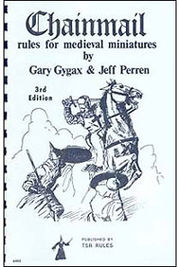
So does that mean I won't stoop to buying or downloading a PDF from RPGNow or DriveThruRPG? Of course not. The internet is a great place if you know what you're looking for, and even sometimes if you don't. I just got a PDF of the original Chainmail rules the other day. I'd be hard-pressed to find an original copy of that lying around, even in Minnesota. I've been thinking about doing a post comparing all the OD&D clones I have and how they compare to the original White Box rules (plus Chainmail). Maybe that will give me a reason to go have my PDF printed and spiral-bound.

#RPGaDay: Day 19

19. Which RPG features the best writing?

Answer: Had I answered this question 20 years ago, I probably would have said Gary Gygax and felt pretty comfortable with that answer. However, in hindsight, looking back at the writing in those early gaming materials - even Gary's - gives me a different perspective on the quality of the actual words. Which is not to say that Gary didn't create some great material. Of the early rulebooks, Tom Moldvay's Basic set was probably the best written in terms of the tightest prose that didn't include a lot of corny jokes or exclamation points. A modern analog for the Moldvay example would probably be Chris Gonnerman, author of Basic Fantasy and Iron Falcon. Chris has a very clean, direct style that is well organized and articulate. It's not inspirational writing that makes you daydream about your next campaign, but it is maybe the most clear and plain-spoken in how it covers the rules.

Someone who takes Chris Gonnerman's clear, concise style of rule-explanation and weds it to inspiring prose and truly creative ideas is Lamentations of the Flame Princess's James Edward Raggi IV. The current Lamentations Player Core Book: Rules & Magic is filled with evocative descriptions of things that by this point are treated with a fairly rote tone in RPG writing. For instance, when describing the Fighter class he focuses on the numb brutality of the life that kind of person would lead. This core book doesn't contain a standard introductory section with a definition of role-playing or any examples of play. It assumes the reader is coming to this book with a working knowledge of RPGs and hits the ground running with character creation and the rules of adventuring. Raggi isn't afraid of painting a very specific picture of what kind of game this is.

More than the core book though, for the purposes of this question, I'd like to highlight his Referee Book from the Grindhouse edition of the rules. There famously isn't a more current version of this book. Raggi has been working on it for years now much to the chagrin of his backers and fans. Because of the long wait, Raggi has put the PDF of the old referee guide up on RPGNow for free. Although I prefer physical books, this free digital copy of his guide should tide anyone over. It contains a wealth of information and insight not just in how to play LotFP, but good advice for refereeing any game. Raggi lays out a whole gaming philosophy that takes a critical eye to the way most GMs run their campaigns. It's a gritty, low-magic, less-is-more approach that emphasizes role-playing, exploration, and investigation over a kill-the-monsters/get-the-gold approach.

The tone of this book is more open and conversational than the Rules & Magic book, but no less direct. Raggi discusses in detail how to build campaigns, the various advantages or disadvantages of different settings or published materials, and the role of NPCs and monsters in the game. Here Raggi talks directly to the reader in a way that he doesn't in the player book. It's well-written throughout and presents a distinct different perspective of how to run a fantasy RPG that challenges the standard Gygaxian methods. LotFP is not a game for everybody; Raggi knows that. Even if the horror vibe of this game isn't something you'd ever run, if you're a fantasy GM you should read Raggi's books.

Saturday, August 19, 2017

#RPGaDay: Day 18

18. Which RPG have you played the most in your life?

Answer: Today's question is an easy one because my first RPG is also the one I played the most. Although I owned Moldvay's Basic very briefly first, Frank Mentzer's Basic red box Dungeons & Dragons was the first RPG I ever actually played. I got it in 1985 and it - along with its subsequent editions (BECMI or Rules Cyclopedia) - was my primary game for the next 4-5 years. Mentzer's Basic set was maybe the best set of rules to introduce role-playing to a new player. It walked you through a mock game to illustrate the different mechanics with examples of play. I heavily supplemented this version of Dungeons & Dragons with 1st edition AD&D books as flavor (deities, subclasses, settings, legendary monsters, modules). I felt guilty at the time for not playing it straight, although I realize now that there were a lot of other people who played it this way too.

As a rules set taken as whole, including all five sets (Basic-Expert-Companion-Masters-Immortal), this system actually developed into something incredibly complex. There are a lot of people who still love this game and the particular flavor it had. Looking back, I have plenty of nostalgia for it and its Elmore-Easley artwork, but there are plenty of reasons I wouldn't want to play it now. Demihumans having race-as-class with level limits, the incredible amount of options and rules at higher level, and the theme-park/kitchen-sink fantasy setting are all things I prefer not to deal with anymore. The last of these reasons is a big part of why I don't want to play the current edition of D&D. The current edition presumes a campaign setting where all fantasy tropes are possible and available which makes for a very complex over-stuffed milieu. It's a setting where magic is common place (almost a professional career track), cities are advanced and cosmopolitan enough to facilitate steam-punk adventures where desired, where monsters coexist in an almost political dimension, and humanoids have more a feeling of ugly neighbors with bad manners rather than real monsters. There's very little mystery or superstition of the real medieval setting which is really more interesting to me.

So even though I've moved on, this is the game that is still my reference point for what role-playing is or what I want it to be.


Thursday, August 17, 2017

#RPGaDay: Day 17

17. Which RPG have you owned the longest, but not played?

Answer: Aside from the newer games I have bought, but have not yet played. There isn't a game on my shelf that I've never played. There are some I've only played a little bit - Star Frontiers, Gamma World, MERP, etc., but all of those at one time were taken around the block at least a few times. Because of this, I've selected an alternate question.

Alternate question: What part or parts of a session do you look forward to the most?

Answer: My favorite part of a session can somewhat be defined by the parts that aren't my favorite. I know that's not a very positive approach to the question, but it might give a more light context if I mention that I generally like all parts of a session. The parts that can be a little tedious are the beginnings and the endings of the session. The beginning can be a little slow if the PCs aren't in the middle of something at the beginning of the session. If they have to go into town and start randomly talking to strangers like it's Ultima from 1986, then you've got to watch out and get your heroes in action. Likewise the end of the game sessions involve a tallying of treasure and experience and all the bureaucratic paperwork that goes along with DMing a game.

With all that preamble, my favorite part of the session is once the quest or mission is underway. Usually by this point the players have warmed up their role-playing skills and will be focused on the task at hand. Also, usually no in the party has typically died by this point. Once they start delving into the earth or at least have taken the story hook, the real fun can by hand. I like when the table finds its groove and things are just humming along. I've got to think this is a pretty common observation, but either way, it's what I've got for now.

Wednesday, August 16, 2017

#RPGaDay: Day 16

16. Which RPG do you enjoy using as is?

Answer: Although I'm not opposed to using house rules in my game no matter what the system, I typically run things pretty close to the book. My Basic Fantasy house rules are few and far between and mostly deal with character advancement rather than adjustments to in-game mechanics. In my recent explorations of the OSR retro clones of old school D&D, the idea of playing these games RaW (rules as written) has been very appealing. Running them straight would really give me the chance to understand how the subtle difference affect what is essentially the same game. For example, how does Iron Falcon compare to White Box FMAG or Delving Deeper? With that in mind, the game I'm most excited to try running RaW is Lamentations of the Flame Princess.

Although Lamentations is really based on the same B/X version of D&D that Basic Fantasy is [UPDATE: James Raggi has made it clear Mentzer's Basic was his inspiration, not B/X], there's enough changes in mechanics in LotFP to differentiate it from BF and other similar games. Moreover the explicit flavor and implied setting of LotFP truly makes it a unique game among all of the others. The point of playing this game for me would be to indulge in its strange and dark milieu. You don't have to play the game in the suggested period of the early modern era, but to me, that would really be the point of playing it as intended - to give you a different experience than the standard Dungeons & Dragons realm. I like the game's built-in default settings: a de-emphasis or outright exclusion of demi-humans (even though they're part of the rules), secret societies, gothic horror, an historical real-world campaign template, early scientific discoveries of machines and firearms, and intentionally including fewer monsters in favor of creeping dread and mystery. I like the game's idea of magic being something metaphysically insane, something that rips at the fabric of reality. Under the hood, this game is mechanically pretty much Basic D&D, but it has a distinct style of its own. It's familiar enough that it would be pretty easy for me to run as written while giving me a new world to play in. I don't know that it would ever be my go-to game, but it would be a fun break from my standard fantasy fare and great game to run completely straight.

Tuesday, August 15, 2017

#RPGaDay: Day 15

15. Which RPG do you enjoy adapting the most?

Answer: Since my recent return to the hobby, I've started exploring some of the new games that have come out in my absence, most of these small, print-on-demand OSR games. In a lot of these cases, these have been strict retro-clones or approximations of some version of D&D with the house rules the creators used to play in their own games back in the day. In a few rare cases, these OSR creators have created something truly new using the spirit of those old games. My pick for day # 15 is Whitehack, a game which I've bought but have yet to play.

Whitehack was built for adaption. It's less a rule set than it is a framework on which to build a fantasy setting of your own design. It's a guidebook on how to build a game of your own. It provides a perfect opportunity to eschew some of the more common tropes and cliches of fantasy role-playing. I could easily imagine myself creating a humans-only Conan/Hyperborea kind of world or something stranger and weirder, maybe some courtly hellscape.

The character creation process involves a custom, GM-designed intersection of class and groups, where the former are vague categorizes (Deft, Strong, and Wise), and the latter are ability-score influencing characteristics (think race, background profession, and affiliations). This allows for multi-dimensional characters that don't fit into the neat boxes of other games. It makes each character very unique and one-of-a-kind. The mechanics themselves are different and it's taking me a while to understand just how things. work.

As I mentioned, I have yet to play this game, but I'm excited to try it out and truly make it into my own. It's the RPG that I hope to enjoy adapting the most. In the end we'll have to wait and see. Have any of you played this?

Monday, August 14, 2017

#RPGaDay: Day 14

14: Which RPG do you prefer for open-ended campaign play?

Answer: In many cases this answer could be "any of them." I suppose I would choose Basic Fantasy because of its generic quality. As a GM I can make the flavor whatever I choose. There isn't a lot of predetermined setting or flavor that I need to remove before making it my own. I've chosen another alternate questions today which I think compliments the standard one nicely.

Alternate Question: What gives an RPG its ‘replay value’?

Answer: Replay value suggests an open-ended campaign. It means being able to take the story wherever you want to go for as long as you want to go there. The last part of the previous statement is key. What makes you want to continually return to a game, again and again? I think there are a few important characteristics which provide this answer.

The first thing that makes a game easy to return to and play again, for me, is the lack of a predefined setting. I'm not talking about genre tropes. I'm talking about a detailed setting that is so well defined and staged that there's hardly any room for the PCs. This happens a lot in games that deal with some well-known IP, think Buffy, Marvel Super Heroes, MERP, or Star Wars. For me, theses types of games are immediately limiting because they are so bound to the story and world that has already been established. To me, it feels less like role-playing and more like playing dress-up. Don't get me wrong, these games can be really fun. I had a lot of fun playing MERP when I first bought it, but the campaign was always set amidst the larger Tolkien narrative making whatever we did feel like a second-rate spin-off.

Part of why I like Basic Fantasy so much and refer to its generic quality as a bonus is because I don't have to strip anything away like I would with Greyhawk, Faerun, or Mystara. BF gives me just what I need and nothing else. The rest is left up to me. As I understand it, Lamentations of the Flame Princess creator, James Edward Raggi IV, was initially a Basic Fantasy guy. LotFP grew out of his BF campaign and the way he played the game. I think his game is really great, but it lends itself to a historical 17th century setting, which again, is bound by the constraint of history. I guess what I'm trying to say is that replay value is directly proportional to how much room gives me as a GM.

Another thing that makes a game replayable for me is a limitless breadth and depth, or at least as limitless as my imagination. This is why I also tend towards fantasy. Science fiction can be fun, but it will always find it beholden to the laws of physics. Science fantasy allows for awesome, unscientific things like light sabers. Part of the reason I think D&D has been so successful for so long is because it is incredibly deep and all-encompassing. True, by this point, D&D has its own history and tropes that box it in, but the different versions throughout the years have shown how the game has remained flexible enough to change throughout the years. The OSR games I love right now are just a continuation of that.

A final reason to what gives an RPG replay value is how much I like the genre and the particular flavor (or lack thereof). This can trump the first two reasons. As confined as MERP was in its parameters, it had more replayability for me than another similar game might because I love LotR so much. In the end, we love what we love.


Sunday, August 13, 2017

#RPGaDay: Day 13

13. Describe a game experience that changed how you play?

Answer: I'm a little worried I'm going to run out of alternate questions before this month is up. I've already answered three and this will be my fourth not even half a month in. I've just recently come back to gaming, so any revelatory experience I might have had has been lost in the haze of the past. I stopped playing instead of changing. It will be interesting to me to see if I have a different perspective on gaming so many years later and if I will be challenged to change my play style in this new world. Any who, onto today's alternate.

Alternate question: What do you want out of an RPG experience?

Answer: I'm going to start my answer by referencing this comic book ad for the Moldvay/Cook/Marsh B/X version of D&D. For whatever reason I associated the kids in this ad with the ultimate role-playing experience. I even used to dream about one day have a table and chairs like ones in this picture. Why? Because they look like they're having fun, which is what anyone wants out of an RPG experience. But what then constitutes fun?

For me, role-playing fun means losing yourself in the story, feeling like you're in the midst of the action, on the verge on solving a mystery. As a GM it means watching your players thrill to the world and the adventure you've set before them. As a player it means playing losing yourself in the character and feeling good that you were able to work out the puzzle, make it through the last fight by the skin of your teeth, or find the secret door out of the dungeon. I want to imagine myself in a stranger, more magical world than the one I normally inhabit.

In terms of tone, my perfect RPG experience would have some laughs, but it would also have some weight and gravitas as well. I want to feel the thrill of danger and risk as a player and the excitement as a GM of knowing the PCs are getting to the good part. Any good RPG should be able to give you that thrill of suspense, and wanting to dive forward to see what happens next.

Saturday, August 12, 2017

#RPGaDay: Day 12

12. Which RPG has the most inspiring interior art?

Answer: Advanced Dungeons & Dragons. I realize this probably sounds like a stock or lazy answer, but if I'm being honest with myself, the interior art for this version of the game was the most inspirational to me. Everything from the core rulebooks, to the supplemental hardbacks, and all of the modules, from 1977 to 1985-ish, set the tone for my imagination in regards to RPGs. The stable of regular artists in these books engraved images in my brain that will be there until the day I die. Trampier, Sutherland, Dee, Rosloff, Williamham, Holloway, Truman, and Otus among others formed the greatest all-star art team of all time, to my mind. Plenty of people have gone on and on about the work done in the PHB, the DMG, and the MM that I don't think I need to go into much detail there. I've also already highlighted Erol Otus's B/X cover during RPGaDay, and although to me Otus was the true genius of the group, I wanted to highlight a different artist that not as many people talk about.

Specifically, I want to highlight Russ Nicholson and his work in Fiend Folio. Russ's style tapped into a malevolence and an evil brutality that I don't remember being equaled until Lamentations of the Flame Princess. While the creatures he drew were nightmarish enough, the look of horror and terror in the eyes of the adventurers he drew told just as much of the story. It wasn't just the gory and sinister content that makes his work so compelling. His style, at least in the Fiend Folio, features a speckled almost grimy look to it. Russ's work inspired me because it drove home for me just how scary it would be to climb into a hole in the earth and then watch your comrade fall in battle to some minions from hell before being disemboweled on a cold, stone dungeon floor.

Here are a few examples of what I'm talking about.


GM Notes - Morgansfort Session 14 - Death Frost Doom - Part 2 of 2

So, here stands the final chronicle of my two-year Basic Fantasy campaign. It ended a year ago and I'm just now getting around to fini...