Here is my submission for this year's One Page Dungeon contest. It's my first time making a one-page dungeon at all let alone submitting to this contest which is in its 10th year. It's a great exercise for any GM to do, to try to get a couple hours of play onto one sheet of paper. It should be something that gives the GM running it everything they need to know, nothing they don't, and still provide a spark of mystery and magic to draw everyone into the story.
I think the less writers talk about their own work, the better. The piece either stands on its own or it fails. If I have to explain it or tell you what I was going for, then it's already too late. If anything, I think I may have bit off more than I could chew given the restrictions of the medium. I'd like to flesh it out into an 8-16 page module with specific stats geared towards old school D&D systems, but you could technically run a lot of different genres through it as is. Maybe I'll even throw it up on Lulu at cost. We'll see. For now, here it is as a one-pager for free.
Saturday, May 5, 2018

Friday, March 23, 2018
GM Notes - Morgansfort Session 5

The party stops outside Mordoch’s lab and decide to take
the passage south – the one passage in this area they had yet to explore. They
oil the door to keep it from squeaking. They move into a room where they find a
roomful of discarded weapons in poor condition. After breaking into a cabinet
and chest, once Pater failed at picking the lock, the group finds a small
arsenal of weapons in good condition, including a nice suit of chainmail and a
sword which are obviously of special make. In opening the chest and cabinets,
they attract a group of three ghouls with the noise they make. The battle is
over quickly, but Nyphus is struck and paralyzed for a couple of turns. While
he recovers the others hide the usable weapons and take the exceptional
chainmail and sword with them.
They move through the passage west until they reach
another room of similar size and shape. This room contains a pedestal with an
offering basin on top. Pater discovers small cones of incense inside a
compartment in the pedestal. The walls are covered with ancient-looking murals,
fresco-style of a primitive tribe of people kneeing and genuflecting towards
the passage west. The group continues onward.
Further on, the passage ends with two huge, bronze doors.
Pater attempts to pick the lock, and succeeds. The lock gives with a loud
clunk, but the door does not open. They then try to force them open through
brute strength, but to no avail. Mel casts Detect Magic both on the door as
well as the armor and sword. All three show a magical enchantment. Nyphus dons
the new armor and Renic chooses the sword. Pater goes back to light the incense
to see if that helps open the door. He returns and further attempts are made,
but with no affect.
The group then hears human voices coming from the mural
room. Wary, they go back to find the room filled with close to a dozen men and
women in ragged clothing. The incense freed them from their prison within the
walls’ mural. They speak a crude and archaic dialectic of the common tongue.
They were members of the barbarian tribe who lived in the fortress two
centuries ago. As the fog clears in their heads they can remember their
complicity in the awful crimes against their own children. Mel makes an attempt
to comfort them and gently tells them where they are at. They tell the party
they do not wish to stay in the fortress.
The party begins to lead the newly-awakened tribe members
out of the dungeon. Reaching the second floor, they can see the kobolds moving
things through the entry chamber down the hall. They creep past the creatures
undetected. As they head up the north passage, they hear, then see the two,
unfriendly black-robed men they met a couple weeks earlier entering a room to
the west. They follow them into the room which is empty. Mel finds a secret
door in the corner and they continue down a back passage west out of the
dungeon. The dungeon opens out into a cave where a small pack of wolves have
been slain.
They come out of the cave onto the western slope of island
outside of the fortress close to where they hid their boat. They notice their
boat is gone. Coming out from the trees and underbrush they saw the two figures
crossing the river with two boats (their own and the party’s). Waiting until
they are out of site, the group follows down to the river. Nyphus strips down
and swims the channel to retrieve a boat. It takes some time to get the entire
group including the dozen barbarians to the other side.
Grelda confronts them in her front yard and asks them to
come inside her home. They leave the barbarians upstairs while Grelda leads the
PCs to the basement where she presents the two robed men, tied up.
Saturday, March 10, 2018
Anticipating Into the Borderlands: Revisiting B1 and B2

Into the Borderlands is a compilation of both the original modules along with 5e updates of the adventures. Even though I don't play 5e D&D, I still may get this just for the new format and to have nice, clear copies of each (hopefully the Otus Minotaur is in there). My happiness about this release is really not about me owning a copy though. I'm happy that newer DMs will get to experience these modules because they fill a gap that I've noticed in modern editions. B1 In Search of the Unknown and B2 The Keep on the Borderlands are two of the best training adventures for both players and DMs ever made, and they prepare gamers to create their own worlds in a way that perhaps modern RPG products don't.
Although I've played in very few modern D&D games, I've noticed a lot of current DMs rely on published adventures and campaign content for their games, much more than I remember doing in the 80s. Sure, everyone liked having the rite of passage of playing through classic adventures like Isle of Dread, Tomb of Horrors, and of course, B1 and B2; but the adventures I remember playing as kids were mostly of our own design. Coming back to gaming in the past year, I don't hear as much talk about people creating their own campaign worlds, at least outside of the OSR community. I see videos about how to run Curse of Strahd or Tomb of Annihilation, but not so much about how to come up with your own stuff. The OSR, by comparison, is all about sharing random tables, one-page dungeon advice, and sandbox toolkits. Meanwhile, the mainstream D&D community seem to view home-brewing as an eccentric option for fringe DMs who choose to miss out on the brilliance of the Forgotten Realms (not that there's anything wrong with FR).
It's possible that this is just my warped perception and foggy memory. However, I see a lot of new DMs asking questions on Facebook, G+, and other forums that I learned the answer to by playing Borderlands. Looking through my new POD copies of B1 and B2, I've started to understand their genius through a new lens of experience and perspective. These two early modules intentionally left a lot of space for the DM to fill in. B1 is completely un-keyed in terms of monsters and treasure. The DM is given lists to choose from and some advice to not use everything and leave some rooms empty. The inhabitants of The Keep in B2 are unnamed beyond their profession, leaving it up to the DM to provide their motives and backstory. B2 also doesn't direct you very much on how to get the players to the Caves of Chaos or give you some overarching plot to move the action. It keys the locations, but you need to make sense of it.
By modern players' and DMs' standards these two modules might seem incomplete, possibly not even suitable for publication compared to newer tomes filled with lore and legend in every hex. B1 and B2 don't do all the work for you. DMs have to do some heavy lifting and players need to ask questions and be curious. These modules don't lead anyone around by the nose to high adventure.
I'm curious to see how this new release plays to modern, 5e D&D gamers. My hopes are two-fold. First, I'd love for this book to teach newer generations of gamers how to think for themselves and come up with their own content, and how to be confident enough in their own ideas to fill in the details on-the-fly. Second, I'd love to introduce or re-acquaint the 5e crowd to the old school way of doing things, where you don't have to rely on official product to tell you how to D&D. We all love fancy new books, but in the end our own imaginations are the best engines of fantasy. I realize it's absurd to expect a complete sea change to happen, but a little bit of old school wisdom wouldn't hurt at all. It would also help to bridge the gap between editions a bit, and that's always a good thing.

Tuesday, March 6, 2018
Challenge Ratings: Why To For Make So Hard?
 |
| Erol Otus is the best. |
What's strange is that I find stat blocks to be the easiest part of designing a creature. It's literally a handful of numbers. The difficult part is coming up with something that looks and behaves in a new and mysterious way. It's tough to come up with something the players haven't encountered before, yet sounds plausible, not something that feels like a bunch of monster parts Frankensteined together from random tables, like a dwarfs head with a unicorn horn, a Displacer Beast's tentacles, and the trunk of a Roper.
The main issue for him was being uncertain of whether he was creating something too hard or too easy, and he found the whole 5e challenge rating system confusing and difficult to wrap his head around. I asked him why worry about it. If you make it too tough, you're players can run away and figure out a way to defeat it tactically. If it's too easy, have two or three more come around the corner.
Challenge Ratings are something I don't really understand the need for in D&D. Perhaps it's just because I have enough confidence and experience to feel what the right difficulty is. I don't really need to think about it anymore (if I ever did), and I certainly don't need to consult a set of rules for encounter balance. And if the first-level players don't do enough information gathering, ignore the blatant warnings, and go traipsing into the temple of a slumbering chaos demon, well, they get what's coming to them.
Say you have a standard D&D adventuring party of a couple fighters, a cleric, a magic-user, and a thief - all around 4-6 level. How many ogres would you pit against them. If the setting and environment would support it, I would probably throw six at them. I would expect the party to (mostly) survive the encounter, but it might get a little hairy there depending on how the dice go. If the same PCs were 1-3 level I'd probably cut it down to two, maybe three. What's more important to me is picking a Number Appearing that makes sense for the environment that the players are exploring. In the above example, if six ogres would seem overcrowded in the area encountered, then I'd only have there be three, but just make them tougher.
That's just off the top of head. I'm sure someone would consult some official WotC oracle and tell me all the ways that encounter isn't balanced. Here's the thing: I don't care. If it proves too deadly, the worst that will happen is one of the players (or maybe more) will be making a new character. If you already have a predetermined outcome for the adventure, why play through it? Let things go wrong. That's part of the game. What do you think?
Sunday, March 4, 2018
The Corniness Threshold of High vs. Low Fantasy
 | |
| ARCANE BARCALOUNGER |
There's way too much magic, too many superpowers, and an endless smorgasbord of player character options of classes and races of increasing silliness. The artwork matches this themepark/kitchen-sink setting where the weird and unusual - the truly magical - becomes mundane. It all crosses a threshold of credulity for me. Sure, I realize I'm complaining about my fantasy RPG having too much fantasy in it, but we all have a line where too much is too much.
All of these player options and powers in current 5e D&D are very popular - many feel the more, the better. At the same time, I doubt those players psyched to play a Tortle Monk in the style of Kung Fu Panda's Master Oogway would think playing something like a walking Lollipop Accountant to be just dumb. Everyone has their threshold.
I sometimes find myself watching 5e YouTuber character-build videos for a laugh, watching people talk seriously about playing something like a Dragonborn Paladin Warlock. To me, this is not any less corny than playing the aforementioned Lollipop Accountant, or an Arcane Barcalounger (see above). I don't really want to turn this into a rant of Bad-Wrong-Fun. If playing a Half-Dragonfruit Druid of the Lost Circle K is where it's at for you, go for it.
I've spent a lot of time recently trying to determine where this threshold lies for me. This is something I've always struggled with. Back when I played AD&D in the 80s, I was never particularly fond of Gnomes, and Half-Orc PCs were just right out. I've always been okay with the four standard Tolkien races (human, elf, dwarf, halfling), though lately I've even questioned these. Humanocentric games/campaigns have begun to appeal to me more, but I don't know that I'm absolutely done with demi-humans yet. I've been buying a lot of sword & sorcery-style games like Low Fantasy Gaming, Barbarians & Basilisks, and Crypts & Things. While these are all very cool, there is a definite jockish vibe about them and a real slavish worship of Howard's Conan. I'm sure from simulationist wargamer perspective, my preferred milieu is just as cartoony as I think 4e was, because perhaps it doesn't have enough historical, fact-based realism behind it.
Finding other players who have similar tastes and attitudes about how much fantasy is the right amount can be just as important as finding people who like the same systems or mechanics. We're all a little goofy in our preferences and we all take ourselves and our elf games a little too seriously from time to time.
Tuesday, February 20, 2018
Review: BF3 Strongholds of Sorcery: The Glain Campaign

This module by Chris Gonnerman, Stuart Marshall, J.D. Neal, and Steve "Longman" McKenzie is a follow-up collection of adventures set in Gonnerman's own Glain campain. The first Glain collection, BF2 Fortress, Tomb, and Tower, was released a couple years ago. This new book is comprised of four meaty adventures loosely tied together by the theme of all taking place in wizard strongholds as well as some small, but direct connections within the adventures themselves. As it goes with any module review, if you're not a GM, you probably shouldn't read further.
The first adventure, "Castle D'Angelo," is a sequel to BF2's "Fortress of the Iron Duke" and it's even recommended for at least one of the characters to have gone through that adventure first. Although there are a few superficial similarities between this module and the old TSR module, X2 Castle Amber (Chateau d' Amberville) - namely being trapped in the castle of a famous and insane wizard family, the link to BF2 makes it a distinct work. Essentially, the demon Khaadk from BF2, still imprisoned in his cracked jewel, has been used as part of a plot to bring ruin on the Duke D'Angelo. The power of the jewel has trapped all inside and has driven them insane. Once the PCs enter the castle they can't leave until they safely contain the jewel, all the while trying not to kill the innocent, though insane, inhabitants. They must also not fall prey to Khaadk's periodic waves of insanity themselves.
This adventure is designed to degenerate into absurdity and madcap farce. Comedic roleplaying is actively encouraged, something which is all too rare in most RPGs nowadays. The whole thing comes off like a cross between a Fellini dreamscape and a series of Monty Python sketches. Aside from the central premise of the module, there are a number of encounters that are worth pilfering even if you don't plan on running the adventure straight. The Chattering Mask is a simple element that could be put into any adventure as a way of giving background information to the players if they ask the right questions. The encounter with the drunken high priest, Herman de Groot, contains fantastic, quick rules for drinking contests or even just mechanically codifying the effects of intoxication. Other encounters like Tia's Dollhouse and the Engine of Enchantment make for memorable small encounters. This is a long adventure, so it could be played over the course of half-a-dozen sessions. In the end, removing the curse could be beside the point if the players are having fun.
The second adventure, "The Tower of Light," on the other hand, has an explicit internal game clock. The PCs must stop the wizard, Rurik Evidur, from collecting the mysterious and dangerous substance, aqua lumina, before he absconds with it to sell on the black market. Even if they fail at stopping him in the radioactive tower of Liddan Nu Madar, it could provide a jumping off point for a series of adventures in pursuit of the wizard conman who's always one step ahead. It could also lead them into the Great Desert of Glain where they might later encounter a portal to the grey plane of Nazgor, or provide them with a solution for disposing of the magic sword possibly found in the next adventure, "The House of Coldarius."
"The House of Coldarius" is another adventure that has a deadline for the players. The PCs must rescue the young wizard, Rafaela, before the ancient vampire/wizard, Predmore Coldarius, sacrifices her to create a terrifying weapon (a vampiric longsword) using the strange substance, nocturnium. This adventure plays like a game of beat the clock in a fun house of Universal movie monsters. There's a vampire, a lycanthrope, a flesh golem, and a mummy. Again, this is another adventure where "failure" may yield just as interesting of results as "winning." It also offers a gateway into another world, Moonmist Moor, a Bronze Age realm with its monolithic Spires warding off the spectres haunting the sky above.
Finally, "Thaumerion's Tower" plays like a tomb raid for a wizard who isn't dead yet. Thaumerion is a wizard and a scholar who has discovered the secret of immortality through imbuing himself with the regenerative powers of trolls. Incidentally he also invented the crazy deadly creatures which are troll mummies. Along the way, you come into contact with a harem of wights, a succubus, and a handful of fairly nice magic items. Even if the PCs defeat Thaumerion and dispose of his abominations, they still might want to get rid of all his written treatises on trolls lest someone else figure out his secrets. There's one in "Castle D'Angelo." They could start there.
This is a great collection which could be used for pretty much any old school RPG, free from the Basic Fantasy website (here) or available from Amazon or Lulu for very cheap (here and here).
Saturday, January 27, 2018
GM Notes - Morgansfort Session 4

After rising and gearing up, the party walk across the
fort’s square to a small abode with a rune etched on its door. Thelan answers
the door, invites them in and begins to question the party as to what they
found in the fortress. They are cagey at first, but open up once he explains
that he was once an adventuring wizard, now retired. They recount their recent
adventures in the fortress. He seems very interested by their finding of the
lab of Mordoch the Mage. He asks if they still have the Mage’s journal, to
which they reply they do not. He offers
them 100 gps to go and retrieve the book. When they tell him about the
sheep-headed riddle creature he seems incredulous before determining that they
in fact encountered a Curseling. He tells them it is a creature of fairy tale
nightmares, a lesser demon who enters the world through the shadows of those
who died while not touching the ground (particularly the hanged). Thelan seems
rattled by this information and not as interested in the journal. In fact, he
tells them he plans to leave Morgansfort in two days for good. If they do not
return with the journal by then, he will be gone. He begins to start packing
his belongings as if in a panic.
A knock sounds on the door. Baronet Halden Rathwynn
accompanied with a small squad of guards are in search of the party and heard
from Lorynn they were at Thelan’s. The party follows Halden to the inner keep
of the fort where he brings them up to his rooms. There they meet Bailiff
Tomandy who, along with the Baronet, questions them about what they’ve found at
the fortress. They recount their adventures, including the nightmares and the
haunted nature of the fortress. They mention Grelda, but neither man seems to
know who she is. It’s the mention of the presence of goblins and kobolds that
gets their attention. They seem annoyed that the party let one of the goblins
go. Halden and the Bailiff wrap up the interview, thank them for the
information, pay them each 15 gps, and tell them to leave the fortress to the garrison
of Morgansfort. Mel asks what they plan to do about the island fortress. They
calmly explain that they plan to route the fortress out completely the
following day, burn the entire grounds, and seal off the dungeons below
forever. They ignore the party’s warnings and send them off.
The party regroups and decides to head to the fortress one
last time to retrieve Mordoch’s journal for Thelan. On the way to get their
gear Mel stops into the noon service at Chapel of St. Queril where a packed
congregation listens to the ceremony being given by Father Thelbain. A brazier
of incensed offering fills the chapel with scented mist. Mel recognizes the
scent as an herbal healing agent and the ceremony itself as a spell of calming and
forgetfulness (Remove Fear) being cast
over the residents of the fort en masse. She rejoins the group who head out.
The see Grelda outside her house again, working in her
garden. They approach her, tell her they know her to be a witch, and warn of
the Baronet and Bailiff’s plan to burn the island down the next day. Grelda is
nonplussed, but doesn’t seem to be frightened of the soldiers. She tells the
party is the sister of Maien Brai, the herbalist, and aunt to her daughter,
Jyni. She has come to the area to try to convince them to return east with her
to their homeland. She mentions that Jyni has shown great facility in the art
and promises to become a great witch. She bades them goodbye and begins to
hustle herself to prepare for the next few days.
The party row across the river and portage the boat in
the weeds on the hill. They enter the fortress and find a group of five small children
dancing and genuflecting in the stone arcade both to the fountain’s statue and
the altar atop the mini-ziggurat. Pater is the only party member who realizes
that these children are in fact Kobolds wearing something leathery on their
faces. He tells the others, breaking the spell. Creeping closer it becomes
apparent that the kobolds are wearing skin masks of small humans, likely
children. Nyphus and Mel attack from the front while Pater and Renic skirt
around the columnade and attack with surprise from the side. They kill all five
and take the horrid masks for consecration later.
They enter the dungeon. In the antechamber of the first
room chains rattle and Ghazold appears out of the shadows. He smiles evilly at
the party and ascends again to his ceiling perch becoming invisible. The party
move around to the side of the room avoiding the middle under Ghazold. They
head around the pit trap outside the dead Stirges’ room down the stairs to the
west. They move past the bulk of the dead centipedal worm creature which seems
to have pieces of it removed. They enter the dining hall which is still heavy
with the musk of the dead apes. They continue eastward into Mordoch’s lab and
retrieve the journal. They leave the room intending to return to the fort as
soon as possible and deliver the book to Thelan before he skips town.
Subscribe to:
Posts (Atom)
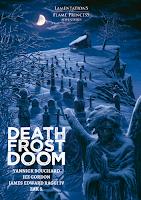
GM Notes - Morgansfort Session 14 - Death Frost Doom - Part 2 of 2
So, here stands the final chronicle of my two-year Basic Fantasy campaign. It ended a year ago and I'm just now getting around to fini...
-
 Jeff Easley's BECMI Thief I’ve recently decided to run an OD&D game. This, of course, brings with it the age-old question of whi...
-
 So, here stands the final chronicle of my two-year Basic Fantasy campaign. It ended a year ago and I'm just now getting around to fini...
-
 Okay, this is going to be a hardcore nerd post. I’m going to indulge into a bit of rules minutiae. I’ve been digging in my OD&D book...