Showing posts with label BFRPG. Show all posts

Sunday, July 19, 2020

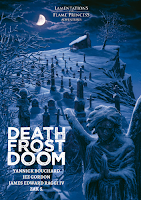
GM Notes - Morgansfort Session 14 - Death Frost Doom - Part 2 of 2

So, here stands the final chronicle of my two-year Basic Fantasy campaign. It ended a year ago and I'm just now getting around to finishing off the write-up. I'll save the campaign summary for the end. For now, let's dive back into the adventure.

The party find themselves in the tomb of one of the Greater Repugnances, the Crypt of the Exalted Interrogator, Aetheldredd Aleph. She begins to question and taunt them, particularly Nyphus, the paladin, who carries on his person the purloined, cursed dagger from the altar in the ice-skull chapel. The paladin and Renic the dwarf take up the attack while Mel, the elven cleric, and Pater, the halfling thief skirt around the melee to check the front door. Nyphus struggles in fight before realizing the mummy is taunting him about the dagger which keeps him from landing blows (due to disadvantaged attacks, see previous post on Knowledge Checks). After Mel and Pater give up on the door, which is barred from the other side, they all join in the fight and best Aetheldredd damaged mostly from bone hooks caused by responding, "I don't know," to her questions.

The crew head back up the air shaft to the kitchen and return to the chapel, finally examining the east door and the basins requiring a gift of a tooth to pass. Once they figure out what is required, Nyphus wrenches out a molar and they proceed. The droning of the Sacred Parasite unnerves them as does the embalming station, the hall of memory, and each of large crypts they briefly explore as they make their way down the hallway. When they get to the Sacred Parasite, they see through the creature's body and realize their quarry, the Miter of Tah, sits upon the altar. Intense (largely fire-based, missile) combat ensues resulting in the death of the creature and the group a bit worse for the wear, two having been paralyzed by liquid time vomit, and all escaping with only a few hit points each.

That's when the crypts started opening releasing the living dead, beginning with the children next to the Parasite. They high-tailed it out of there trying to secure doors as they went.They made it up and out of the cabin before the dead were able to follow. Nyphus used his bridge arrow given to him by the elven deity in the medusa's shrine which created a straight, though narrow shot down the mountain. Zeke Duncaster was likely a goner as would be the village at the foot of the mountain, but the party had to get back to Nemesine's acolytes to take them back to his skyfortress over Ravenstone and give him the Miter of Tah so that he would leave the Western Lands and disband the Green Mark's slave trade.

They make it back through portal and deliver Nemesine the miter, his ticket off of this plane. He thanks the party who then ask what will happen to the undead hoard they now unleashed on the world. He shows them the seaport town where they had sent the freed Mothers of the slave pits. Nemesine explains this small village is just due south of Demonfrost Mountain and will be crawling with zombies within a week's time. Before the party can object to the trick, Nemesine places the miter on his head and the sidhe disappears.

Immediately the fortress begins to crack and slowly fall from the sky. The party follow the stunned acolytes of the Green Mark outside to the portal connected to the chapel. Within the space of a half hour, the fortress crashes into the bay of Ravenstone demolishing ships and buildings. A riot of slaves revolt against the cult and the town. All is chaos and the party climb up into the hill with others to survey the carnage that was partly of their making.

Campaign Epilogue

This campaign was epic compared to the exploits of my youth and a good way to get back into gaming. Although I used the Morgansfort module as the setting I re-wrote and re-worked most of it. Basic Fantasy is a terrific system that I would recommend to anyone looking for a good neutral OSR game. As I've said before, it's like the mix of Basic and Advanced D&D that I had played as a kid if only I had thought of some of the changes Chris Gonnerman made. Going forward, it's what I would use if I want to play a standard fantasy B/X-style game. One of the reasons I haven't bought Necrotic Gnome's Old School Essentials is because it is just a (very good) restatement of a game I already own. I like the changes Basic Fantasy made to that game and I don't think I'd ever want to go back.

However, in running the campaign, I discovered my tastes for the kind of game I wanted to run started to change. I found myself not as thrilled to just play elves-and-orcs/Keep on the Borderlands D&D anymore. I wanted something darker and weirder. It's easy to tweak Basic Fantasy to do what I wanted, but I longed for something I didn't need to tweak. I didn't want demi-human PCs anymore. I didn't want to re-skin humanoid monsters to humans anymore. At least not all the time. When I feel like running that kind of a classic game again, this is the one I'll turn to. I could easily see using something like Titan (Advanced Fighting Fantasy) as a setting, or even Necrotic Gnome's Dolmenwood.

One of my players was a disappointed with the way the campaign ended. He was bummed they had unknowingly unleashed a hoard of undead upon the world. He wanted to know if that had been inevitable. Was there a way that they could have "won," meaning gotten the quest item, not awoken the dead, and not caused the city of Ravenstone to burn in the fires and chaos of a slave revolt. It wasn't inevitable. They could have declined Nemesine's offer since they weren't affected by his Geas. They could have fought him or joined his ranks and freed the slaves from within. They could have left the Miter of Tah where it was. But no, as a party of 3-4 levels, they was no chance for them to beat the dungeon within a couple sessions. He felt that was somehow unfair and had hoped for a campaign end with closure around the various story arcs that tied up all loose ends. To me, that's a narrative story, not a role-playing game. I don't blame the module or the player choices, it's just a mismatch of expectations.

This is biggest hurdle I face going forward. Finding players that are willing to be challenged, not afraid of character death, and open to a system that doesn't have a lot of mechanical player options. I'm willing to hang in there in order to get what I want though. This campaign was a learning experience playing with people used to more modern play styles. There were disconnects sometimes, but mostly the sessions were just really fun.

Thoughts on Death Frost Doom

Death Frost Doom was a satisfying way to end my campaign. Although it has a reputation as a campaign-ender (or maybe campaign-ruiner), I think it could be equally effective as a way to begin a campaign. I can easily see a campaign starting off by a group of hapless 1st-level PCs wandering into this evil cult tomb and unleashing doom upon the land. Okay great, now what are you going to do about it?

Even before I ran the module I considered it among the best adventures I'd read. I know some others disagree. Some find it too slow or too drastic in its outcome. More than this though, I think people take issue with it because they, like my friend above, don't see it as an adventure that is winnable. Personally, I take issue with the notion that adventures should have at least one outcome possible where the players kill everything, take all the treasure, and suffer no losses within a 4-6 hour session. Technically, "winning" is doable in Death Frost Doom. It would just take time, a lot of research, and some divination. The skulls will break, but if the Sacred Parasite is not be killed, the party can lock the doors, take the book of names down the mountain and start consulting sages, looking up rumors, etc. Once they divine the nature of the curse, they could bring a large scale clerical force to prepare to properly deal with the thousands of living dead. Then the Greater Repugnances could be dealt with. It's not impossible and would likely take years in game to do, but if you really want to deal with the evil once and for all, there is a campaign's worth of adventure to be had.

I have read the claim that DFD is a rip-off of an old White Dwarf adventure, The Lichway. There are only two real similarities between the adventures that I could find.

1.) The Lichway is a long corridor filled with 652 skeletons that lie dormant unless disturbed.
2.) The Susurrus (later compiled in the Monster Manual) creates a dronesong that can be heard through the dungeon.

Both of these elements have an analogue in Death Frost Doom, however, they are different enough to make claims of DFD being a rip-off a bit of a stretch. DFD's mass graves contain thousands of undead in separate huge, themed chambers. And they awake based on the ice crystal clock in the chapel and the defeat of the Sacred Parasite (the Susurrus analogue). Mass graves in tombs are pretty common in adventures. The Sacred Parasite's dronesong is the closest parallel between the adventures, but the Sacred Parasite is described as a dirty white balloon with a face like a twisted knot at the end singing its drone, whereas the Susurrus is a 7-foot tall headless gorilla-like beast whose breathing through pores is what makes its sound. Not alike.

There are a few other similarities - a giant spider, a violet strain of black lotus - but on the whole, there's not much there. To my mind the actual evidence of the claims of plagiarism are pretty weak. Maybe I'm missing something, but I don't see it. Not when there are countless B2 copies, S3 clones, and X1 hommages. The cabin in the woods as dungeon entrance, the liquid time element, the ice skull clock, the chapel organ, the Greater Repugnances - these are not in Lichway (as I could see). The Lichway has a lot of water elements and is packed with monsters including new ones like the gollum-like Svarts and toad-ish Spinescales, as well as bog-standard stirges, lizard men, and goblins.

Adventure modules prove themselves in the playing. I found it to be easy to run and my group had a good time with it. You want to know what makes an adventure one of the best ever? The test is not how fondly people remember it or how much money it goes for on eBay. The proof is people still play it after 20 or 30 years. B2, X1, S1, Thracia - people still play these and will continue to play them. I can easily see people running DFD 20 years from now, no problem.


Wednesday, June 12, 2019

GM Notes - Morgansfort Session 13 - Death Frost Doom, part 1 of 2

In the morning, the party leads the group of freed Mothers to the chapel of the Green Mark, down to the crypt, and through the green crystal portal to Bishop Nemesine’s floating cathedral over Ravenstone which is built into a dead titan’s decomposing head. Nemesine leads the group into a small chapel/shrine room of the side of the main chamber. There is an altar, and a bloody magic circle off the floor. Off this chamber is a set of two opposing alcoves, which between them function as a in/out portals, each with green crystals. Nemesine sends the Mothers through first to a small portside town on the western side of the northern continent. The party sees the Tarred Goose in port.

Nemesine then delivers his terms to the party. He will send them with two of his acolytes to an area north in the Demonfrost Mountains, specifically to the foot of Mt. Deathfrost. The top of this peak is said to house the tomb of the Duvan’Ku death cult, the original worshippers of Shah Gzerohn. A group of 12 clerics of Tah sacrificed themselves to seal in the evil there. Also sealed inside the mountain is the Miter of Tah, a powerful relic stolen by the cult which Nemesine seeks to erase his curse and leave this dimension. If the party returns with the Miter, Nemesine promises to disband the Green Mark, end the slave industry of Ravenstone, and leave the known plane. The PCs are welcome to any other treasure found there. Nemesine has also gives them a green gem which will allow them to read ancient runes and writings they may find in the tomb.

The party is equipped with furs, boots, and camping/climbing equipment. They pass through the portal half a day’s journey from the town at the foot of the mountain. Rumors of horror are told that night before an early rise to head up the mountain. Halfway up the mountain the two acolytes take their leave as they cannot approach any closer to the peak without intense mental and physical anguish. A little further on the party discover the shack of Zeke Duncaster, a crazed old trapper who has made his life on this mountain by giving headstones to the unmarked graves at the top of the mountain. One notable marker for Marybelle Walker is in progress. Zeke discovered the names in a book in the cabin at the top of the mountain. He begs them not to proceed and even attempts to stop them short of physically barring their way.

The party reaches the top about 10:00 p.m. The moon shines overhead. The cabin sits at the top of the summit looking down on a huge field of graves and markers covered in snow. An evil-looking dead tree with a hangman’s noose watches them. There is a faint droning sound as they approach the cabin which gets louder the closer they get. They move to the back door where a set of somewhat recent tracks leads off amongst the graves. They find a frozen corpse there in a nightshirt perhaps from a few days ago. There is also a well that the party decides to stay away from after Pater’s episode in the buried elven undercity.

The party enters the cabin from the back and start to explore the back rooms. A harpsichord can be heard upon entering, but it immediately stops as the PCs enter the room with the instrument. That room also features a large painting of the party themselves dressed as they are now, standing before a large skeleton-encrusted altar with a dark passage open to the left of the altar. In the painting, Mel is seen drinking from a cup in one hand and holding a handful of fist-sized glass spheres. In the empty bedroom across the hall, they find a stash of purple lotus powder which Renik recognizes as a potent natural hallucinogen. They take the lot. They find a plain kitchen and a front room with a fireplace, mounted stag head, mirror, a clock, and a desk with a book of millions of names of sacrifices going back millennia – the last few pages full of Zeke’s checkmarks. There are also three chairs that face the party as they come in. The mirror is cold with runes for “every brother” and “every sister” on either side. The stag’s eyes are cloudy and bubbled. Oh, in the middle of the room is a trapdoor on the floor with a padlock on it.

Before trying the padlock, the group inspects the last bedroom where they find the belongings of the corpse outside, one Norquist Orve, a mountaineer and tax dissident. His journal details the path he took up the mountainside, not the longer, cleared path the party took. They take some of his climbing gear and rations and go back to the trapdoor which the unlock and open, exposing a dark shaft, 50’ deep with iron rungs inside. They descend without light as there is no room for lantern or torch within the shaft. Renik and Pater spark a witchfinder candle at the bottom. The droning becomes louder with the opening of the trapdoor and as they go down.

A long hallway of crystalline walls writhes with agonized faces calling out in a lost language. It ends with a door with a gargoyle’s head as a lock. A key is in the lock which requires one to place their hand in the mouth. Pater is volunteered and the door opens and he takes the key. An antechamber of small table with severed hands holding quills next to parchment with the instructions to “transcribe” and “replace” carved into the hands. A set of bronze double doors to east feature a huge sigil, the sign of the Duvan’Ku. The party opens the doors and lets out a gust of cold air.

The group enter the large chapel of the Duvan’Ku. The room is shaped like a blunt-tipped arrowhead pointing east. Rows of stone slab prayer plinths cover the floor. Twelve ice skulls hang from a ceiling fixture. An altar inside a huge skull is at the far end. To the left of the altar is an organ made of bones. Murals adorn the northern wall, one of hanged women with a caption, “name them, but build no monument unto them.” Another mural shows a man being stabbed with nine swords and thrown into a pit as an offering. Two sinks of black water are attached to the southeastern wall and filled with teeth. The Duvan’Ku rune for “gift” is atop the basins. There is a large bronze door with a wheeled lock on the east wall between the altar and the sinks. Another small door leads out in the north wall.

The group inspect everything. Nyphus finds and takes a jewel-encrusted dagger and a ruby necklace in a bowl on the altar. One of them (Mel?) attempts to match the note on the organ to the increasingly louder drone to no effect. Pater or Renic fish a locket with a portrait of a man out of the teeth basin. It matches the picture of the man in the mural stabbed by nine swords. During their time investigating two of the ice skulls hanging from the ceiling have fallen to the floor and shattered. Water drips from the others. The group contemplate pulling out a tooth to offer as a gift in the sink but instead head through the north door.

They enter a hallway with many doors. They try the room to the right which contains dirty bedclothes and cots. Searching discovers a wooden mask with human teeth (obviously taken from the basin) inserted into it. The door to the left reveals a small set of rooms – one locked (that they can’t open), a toilet, and a library with a map. They copy the map on a sheet of paper and move on. The next room on the left off the main hallway is a kitchen/eating area with marble benches and a firepit. The upper walls are stained with smoke. Pater searches the cabinets and the upper walls, and finding no ventilation, discovers a place where there are no stains. A small panel in the ceiling is found with a passage or flue about 5’ x 5’ heading above the room. Pater goes first, and the rest follow, but it is a tight fit.

The passage leads into the ceiling of a room with an elaborate bone-encrusted sarcophagus with a scene on the top in bas relief of hundreds of beheaded men on a battlefield. The top is removed and a desiccated female mummy rises. Nyphus addresses her. She looks at him and asks him, “What do you carry?”

Sunday, April 21, 2019

Top 5 Desert Island RPGs

This is in response to DravenSwiftbow’s recent video of his Top 5 Desert Island RPGs. Dave gave a good, solid list which emphasized diversity of genre and system over depth within any one game. He picked self-contained core rulebooks (and one box set) which makes sense. He ended the video asking for people to give their own lists of whatever number or classifications in the comments. Because I’m a wordy dum-dum, I decided to write a short blog about it rather than dump a huge block of text in Dave’s comments.

There are too many ways to do this I’m going to multiple lists. First, I’ll try Dave’s idea of multiple genres. I’m not a big sci-fi fan, but Warriors of the Red Planet would give me exactly what I want from that genre in one slim little volume. For horror, I’d pick the sixth edition of Call of Cthulhu because it’s in one volume (and it's the one I own) and benefits from the advancements made over several editions while still hewing closely to the original vibe. For something more exotic, Empire of the Petal Throne is perfect for its complete world that's intriguing and mysterious. (I just realized that Geoffrey McKinney’s Carcosa falls at an intersection of all three of these games.) For something to fill the D&D slot, I’ll pick the Holmes Basic box set – either the first printing with the geomorphs and the monster & treasure assortment, or the next one with B1. It may only go up to level 3, but you would be free to extrapolate the rest as you saw fit, and in terms of a ruleset that really totemically gets to the core of the D&D vibe, it’s hard to beat. I’m not really big into superhero games or cyberpunk, so I don’t really have a fifth pick. I guess I’ll choose MERP for nostalgic reasons.

Another way to look at this is to pick setting books, modules, and toolkits instead of an actual game system. Once you’ve played TTRPGs for long enough, it’s easy enough to pick a core mechanic and make up your own system. Many of us can play D&D without the rulebooks by now, so perhaps the best bet would be to bring something with lots of random tables to help generate an infinite amount of adventure. The danger with just picking modules is that it’s an endless trap. Picking five modules to run forever is pretty limited, no matter how sandbox-y they are. There are about five really good megadungeons out there which would keep you busy until the end of time, but it would get a little same-y after a while. Campaign settings can be really good and open (various 2e AD&D, Dolmenwood, and Midderlands), but their specificity doesn't always give you the latitudes you might like.

As far as toolkits go, books like Veins of the Earth can give you procedures to build your own campaign world, but you need to choose them wisely to give you a breadth of settings. You could choose something like the Fight On! compendium of Vol. 1-4, John’s Stater’s NOD or Hex Crawl Chronicles, or James V. West’s Black Pudding collection which are all filled with great ideas. The Judges Guild really perfected this kind of variable setting supplements with their Ready Ref Sheets, City State of the Invincible Overlord, Wilderlands of High Fantasy, Dave Arneson’s First Fantasy Campaign, and any of their early modules (Tegel Manor, Caverns of Thracia, Dark Tower, or Citadel of Fire). You could do a lot worse than just picking five things from the early JG stuff.

In terms of something self-contained, any of the OSR retroclones would really do the trick. Basic Fantasy, Swords & Wizardry, Labyrinth Lord, Delving Deeper, OSRIC, DCC, Lamentations of the Flame Princess, Blueholme, and many others give you everything you need in one book. In all honesty, one of these games is all I would need. Whatever you wanted to change you could house rule into your own system and in a lot of cases the clones are easier to run than the original games because of some of their modern innovations. However, these kinds of desert island questions aren’t just about practical usefulness. It’s about inspiration too, and that doesn’t always match what’s pragmatic. Sometimes it’s about what brings you joy, even if that comes from a place of nostalgia and sentimental attachment.

To speak to that, although it would be nice to have a breadth of systems or genres, in the end, I really just want to play some form of D&D. It’s my first love in this hobby and what I’d choose over anything else. If I was going to Frankenstein a nice feel-good collection of five D&D products, I suppose I would pick the Moldvay Basic set (with B2 Keep on the Borderlands), the Cook/Marsh Expert set (with X1 Isle of Dread), the 1e AD&D Dungeon Masters Guide by Gary Gygax, the 1e AD&D Monster Manual, and the original edition’s Gods, Demi-Gods & Heroes (the original, unedited version, not the incomplete WotC resissue). Even though these five span three different editions of the game (0e, 1e, and B/X), this is D&D to me. I’m one of those people who feel all TTRPGs in some way are just house-ruled versions of the original (this drives people nuts, sorry).

In that spirit, maybe the best choice of all would be the original game and its four supplements: the white box (with the 3 LBBs), Greyhawk, Blackmoor, Eldritch Wizardry, and Gods, Demi-Gods & Heroes. You can extrapolate everything from these five, and in fact, we as gamers have over the last 40-some years. What are yours?

Sunday, April 14, 2019

New Games and Campaigns

Today's post is really just a way for me to get down in writing what I'd like to focus on in gaming for the rest of the year. My regular Basic Fantasy campaign is winding down. We were going to end it last session, but we needed to cut it short due to time, leaving the PCs halfway through Death Frost Doom. We were supposed to finish it off today, but real life got in the way. In any case, we only have one more session left which means I'll more time to try out a lot more games and put energy into other projects.

First up, I'm working on polishing my notes for the city of Slateholm and submitting it to the Basic Fantasy Workshop. These were all the loose pages of scribbled notes and random tables I used for that portion of my campaign. My players only touched a very small part of it for the couple of sessions they were there and I think there's enough good stuff there to be useful to someone running Morgansfort. My intent with this isn't for these notes and tables to become their own module, but more just in the spirit of sharing what I put together.

Next, I've been slowly working on a draft of an adventure for Basic Fantasy. My idea is pretty large, and I'd like to playtest it before submitting it to the Workshop. At the core is a neat little dungeon idea surrounded by a mini-hex crawl. I think there's a lot of potential for it. I don't think I'll have a draft by the end of the year like I'd hoped, but if I can get the central dungeon written and tested along with the nearby town and surrounds, that will be good.

I'm also chipping away at fleshing out the one-page dungeon I submitted to the One-Page Dungeon Contest last year (I was one of the many runner-up winners). I think I tried to pack too much into the one-page concept and there was a lot of vague details left for the GM to fill in. I was initially going to write this for an OD&D-type system, but tonally it doesn't quite fit (perhaps Swords & Wizardry). There's some body-horror elements that are actually more of a fit for a Lamentations of the Flame Princess or Dungeon Crawl Classics adventure. I'm less comfortable with those systems, however, so we'll see what I think once it's written. I think if I just pitch it to a Basic-style game, I'll be in the ball park, at least.

Speaking of OD&D, I have a hankering for writing a couple of small scenarios for either or both Iron Falcon and Delving Deeper. S&W is pretty well-supported with adventures, but IF and DD each have their own flavor of the early game which I think is worth supporting. All of these adventures will need to be played through too, so I plan my gaming for the next several months to be running various versions of OD&D.

A side benefit to running all this 0e will be that it will help me to really figure out what I like or don't like for my own 0e system I'm putting together. I know that the last thing the RPG community needs is another OD&D clone, but it's really just a way to put my own house rules together in a format to share with players. I'll probably put it up on Lulu for free digitally and a print version at cost, but the main purpose won't be commercially-driven.

I've also, strangely enough, been looking at 5e. One of my players in my local group wants to run a campaign and I'm curious to get a feel for the system that everyone is playing. I've taken a good look at the free Basic Rules, and while I think there is some good things about it, I'm not quite sold on it. There are some things that I still have hard time with. I'd like to give it a fair shake though.

And because I can't leave well enough alone, I've started putting together, not just one, but two different set of hack rules for 5e based on the SRD. In other words, 5e if I had written it. It's a little bit of an experiment. How much can I take out and still stay true to the rules or the spirit of the rules. Can I make a version of the game I'd want to play, but still use the same engine to be 5e-compatible? It's my way of getting under the hood and learning the system as well.

All this for 2019 and I'd still like to play a little Call of Cthulhu and Empire of the Petal Throne as well. I suppose it's better to be busy than bored.


Saturday, March 23, 2019

GM Notes - Morgansfort Session 12


We last left our party across the street from a tenement building in a Ravenstone neighborhood where a cultist they were following had just entered. After a minute of discussion, the group stakes out in an alley while Pater crosses the road and enters the apartment building. Pater hears a voice from the door on the right. It’s a man gruffly speaking in a tone of command. The door begins to open and Pater ducks back into the shadows under the stairs. The cultist exits followed by a chain of very pregnant women. Pater dives and backstabs the cultist who falls under the lethal strike of his blade.

The women, dressed in rags and bound together at the wrists, are shocked, but looked somewhat numb to the violence. Pater asks who they are. A young, dark-haired woman says they are known as The Mothers. They are slaves whose lives are dedicated to breeding slave stock. The unfortunate brother was collecting them to bring them back to the pits from their physician visit. Pater brings them outside and across the street where their bonds are cut. Pater goes back inside to hide the body inside the apartment. He gets the body back inside, but leaves quickly when he hears a voice from the back room ask, “Br. Woodward, is that you,” identifying him as the son of the widow from the night before.

Two men come out of the building just as Pater makes it to the alley after having discovered Woodward. The noon bell tolls and the streets begin filling with townspeople making their way to the chapel. The group find a (for now) empty house where they hole up while they decide what to do next. The household is a middle-class home unremarkable except for the oil-painted picture of the demon lord, Shah Gzerohn, in multiple rooms. The townspeople are apparently true believers. Nyphus and Mel head to the chapel while Pater and Renic head northeast towards the industrial warehouse section of town. They find an abandoned storeroom on the edge of town.

Pater leaves Renic in charge of the Mothers while he leaves to watch the chapel. He meets two men on the street on his way there. Renic leaves the Mothers alone to keep from being left on guard duty. Nyphus and Mel make their way in to the chapel from near back of a long line. The middle of the chapel contains a giant green crystal  coming up from the floor. Both make their way downstairs to the sacristy where a line of worshippers are entering a portal through the crystal. Nyphus enters the portal, Mel does not until later under pressure from the evil brotherhood after she tries to make her way down into the slave pits. They find themselves in front of a giant stronghold on an enormous cloud bank over Ravenstone.

They are given an audience with Archbishop Nemesine in a throne room full of Ravenstone worshippers/townspeople. In the gallery leading to the throne room are large oil works depicting brutal scenes of worship of Shah Gzerohn as well as Nemesine’s personal history. At the end are recent works of the party themselves, saving the early barbarian tribe from the mural in the dungeon of the Island Fortress. Nemesine is a Sidhe, a faerie being from another world. He and his lover are exiles from their home world and were cursed by clerics of Tah shortly after their arrival in this one. He cannot walk the earth in his true form and may not leave this one for another. Here on the cloud demi-plane he at least may cover his hideous new form, a mass of writhing maggots. His lover, similarly disfigured, committed suicide.

Nemesine fails to Geas both Nyphus and Mel. Instead he offers them a deal. He seeks the Miter of Tah which was stolen by the Duvan’Ku, the original worshippers of Shah Gzerohn before the barbarians. The cult was vanquished 700 years ago in their last shrine in the Demonfrost Mountains on a peak called Deathfrost by a group of Tah’s disciples attempting to take back the magical Miter. The clerics never returned, but the cult was also never seen again. It is said Deathfrost’s shrine is filled with gold and ancient artifacts of wonder. Nemesine’s acolytes cannot climb the peak. Their green marks begin to burn and their minds fray approaching the peak. The Miter will let Nemesine remove his curse and leave this plane for good. If the party returns with the item, Nemesine vows to let the freed Mothers go, disband the Green Mark, put an end to the slave pits of Ravenstone, and leave this plane. Mel draws up a contract between them, sealed with the mark of Persephone and Demeter.

In the meantime, Renic leaves the Mothers in their warehouse hideout for the chapel. Pater sees him approach from his hiding place. Renic quickly escalates into a conflict with the acolytes and chops one in two. The fight flushes out Pater as well. They are pursued by cultists, eventually lose them, and meet back at the warehouse. Nyphus and Mel return later with the terms of their agreement, planning to return back to the chapel the next morning.

Sunday, January 27, 2019

Dungeon Digressions: Rooms Apart and Other Ways Out


(Warning: some SPOILERS follow for G1, Stonehell, and the House of Coldarius adventures)

I’ve been formulating an idea of a particular type of dungeon room with which I’ve recently become enamored. For lack of a better term I’ll call them dungeon digressions. These rooms are not only set apart from the general theme of everything else going on around them, but more importantly hint at a larger “otherness” beyond the understood edges of the adventure, or even campaign.

I’ll give you an example which crystalized this concept for me when I recently re-read G1 Steading of the Hill Giant Chief. The room is 17A of the dungeon level, the Weird Abandoned Temple. The orcs on this level (presumably those rebelling against their giant masters) have blocked the door to this temple with rocks, and it is bolted shut. Whether it’s an attempt to keep people out or keep something else in is precisely what makes it so inviting for curious adventurers. Inside the temple the stonework glows purplish-green. The walls chill to the touch and the columns induce nausea. Carved signs and shapes seem to stare at intruders and shift position when not watched. A greasy, yellow-gray altar sits at the far end and beyond it a concave alcove. Staring into the alcove causes visions of sickly mauve and violet tendrils to writhe and stretch towards the viewer, causing insanity 50% of the time. If the viewer doesn’t go insane, they are gifted a scarab of insanity or a 5,000 g.p. gem.

This is a great eerie room heavy on the eldritch vibe, but it’s the room’s context within the rest of the adventure that makes it stand out. This room shows up in the middle of a 9th-level recon/hack-and-slash stronghold invasion with enslaved orcs revolting against giants working for the Drow. There’s a lot going on in this module already, with breadcrumbs, subplots, and portals to the next chain of adventurers in the G-D-Q series. So why did Gary stick 17A (and 18, the blocked-off Vestry sloping downward) into this adventure? Was it a hint or a connection to a cult of evil chaos, or elemental evil? Or does the vision of the alcove with its Lovecraftian feel hint at a Tharizdun connection?

Whatever the intention, the impact is great. No matter how massive and intricate Lolth’s grand designs are in this campaign, this one little room gives a hint of a massive, incomprehensible reality which dwarfs the demonweb queen’s machinations making them seem petty and small by comparison. It’s a small portal, a tiny digression, which drops off a deep end into a larger, abyssal perspective. I love it.

Michael Curtis’ Cenotaph room in the canyon of Stonehell is a very brief version of this with the room’s bas relief intimating the knowledge of a vast sleeping entity lying in wait in a distant land. With that kind of realization, what does it matter if you are downed by a pack of filthy kobolds in some forgotten corner of an underground prison complex. The scale of the PCs’ mortal lives have no meaning by comparison. It does a lot without really doing very much of anything, preparing the PCs for the discovery of the nixthisis at the heart of the underground hell.

The main interest for me with these side-rooms isn’t that they bring a whiff of R’lyeh to the game. The eldritch quality of both is merely coincidental. What’s great about them is they offer a door to worlds older than the mountains in their current dimension. In short, they can be a hook or way out of the current adventure into something deeper and weirder. If they want it, that is. In the case of G1’s 17A, the PCs can decide that what lay beyond the bronze-banded door was interesting enough to abandon Geoff, clear out the rumble in the Vestry, and find their way down to the veins of the earth, so to speak.

One more example I recently came across is in the Basic Fantasy adventure, “House of Coldarius,” from BF3 Strongholds of Sorcery. The adventure largely concerns a vampire kidnapping a wizard pupil to create a dark, intelligent sword. It’s a fun, beat-the-clock rescue in a scary house with various Universal movie monster stand-ins (there’s a vampire, a flesh golem, a mummy, a lycanthrope, etc.). However, in the locked parlor of room 39 on level 7, there’s a black metal arch with silver runes that serves as a gateway to the world of the Moonmist Moor, a Bronze Age realm haunted by spectres who feed off the few humans at night and are kept at bay by huge monoliths called Spires. It’s only a thumbnail sketch of a world, but the strange open possibilities of it, the offer to the party to go “elsewhere” is everything that fantasy should be about.

These kinds of side-door encounters aren’t exclusive to D&D. They can be found all over the fantasy genre. “Riddles in the Dark,” from The Hobbit, is maybe the most famous example. Bilbo gets separated from his party, meets a weird creature, finds a magic ring, and the fate of all Middle Earth changes. Without that digression and resulting alternate way out (literally), you don’t get The Lord of the Rings.

A lot of times the campaigns we create are built around a central, preconceived narrative idea that everything rests on. But these little “dungeon digressions” are important to have in the game as release valves or rifts to other worlds or adventures to keep things unexpected and fresh. What might start as a typical dungeon delve turns into doorway to Barsoom. The heist of a rare piece of art becomes a portal to the Blue Medusa’s maze. A mirror becomes a way into Voivodja. An escape from the city watch through a garden gate leads to a trek into Ynn. A passage through Ultan’s door takes you to the dream world of Zyan, with its masks and puppet masters. Basically, don’t be afraid to Terry-Gilliam your D&D game.

Saturday, January 12, 2019

GM Notes - Morgansfort Session 11


After Nyphus lays down a challenge to the black-cloaked cultists, he starts to cross the street towards them when he hears the whistle of the city guard. He stops in his tracks and waits for the guard to reach him. At the same time, the cultists also begin walking toward Nyphus. The parade, and attending onlookers, remain watchful to see how the drama plays out. Pater, Mel, and Renic blend in to the crowd and watch to see what happens to Nyphus.

The guards approach Nyphus and the cultists and demand to know what’s going on. Nyphus accuses the cultists of evil acts at Morgansfort, and the cultists expose Nyphus and his party as the wanted murderers of members of their order. Things become heated when Jochim, led by the boy from his office the day before, suddenly steps in and advocates on Nyphus’ behalf. With the duties master involved, the guards decide this squabble is above their pay grade and announce that they will bring both parties before the Duke to settle the matter.

A march to the palace follows with guards between the cultist and Nyphus, Jochim, and the boy. Pater, Mel, and Renic all follow separately at a distance. As the group moves into the merchant quarter on the way to the Noble quarter a carriage with the initials, MR, passes them, seemingly on its to the palace too. The procession enters the palace gates, but the rest wait outside before deciding to regroup back at the ship.

Upon entering the throne room, the Duke is seen finishing up some business with a group of elegantly garbed elvish diplomats from Avenrho. It is their ship docked at the wharf next to the Amber Tide and the Tarred Goose. The Duke tiredly asks the guard what this is about. After a brief synopsis of the situation, Nyphus lays out his case passionately. The cultists lay out theirs. During their testimonies two people enter on the side of the throne room, an elderly gentleman in a wheel chair and his much-younger caretaker, a raven-haired woman with cruel eyes. This is Baron Morgan Rathwynn, father of Halden. He recounts the accusations of murder delivered to him by the Bailiff and Father Thelbain. The boy, Caleb, tells Jochim he saw the Baron’s caretaker with a green mark tattoo on her chest while she was undressed. The Duke, not wanting to get involved in a religious dispute, takes each party into his private quarters for an interview. He meets with Nyphus and Jochim last. He tells Nyphus to slip away as early as he can the following morning once the ships are allowed to disembark.

The group go back to the Goose and ask them to leave as early as possible. They gather their stuff from the wagon. They give Jochim the wagon for his trouble. Nyphus thanks the boy and they all leave early the next day. The party and the ship’s crew get on well. Much drunken cavorting occurs.

On the third night of what is to be a two -week voyage, Nyphus has a dream. He finds himself in a long stone hallway. At the end are two fountains. An eerie music plays. To the left is a milky fog of star lights, beyond which is an altar. On the altar, beside two golden goblets and a large book is a miter. Nyphus wakes with a start. The boat rocks restlessly and the crew can be heard up on deck. Nyphus goes on deck as does the rest of the party. Four large Rocs are circling overhead, but do not attack. The crew are alarmed by the great creatures’ passivity and spooked by the strange omen. The next day they Ravenstone is sighted off the starboard bow – a week and a half early.

The Goose’s crew quietly unload their cargo and take off, glad to rid of the strange southerners. The party find accommodations at a tavern/inn near the docks. Mel offers blessings to the fellow clientele in an attempt to strike up conversation and learn any news about town. She meets a middle-aged woman named Mrs. Harrelson, a widow who is proud of her son, a recent acolyte to the Green Mark, Brother Woodward. The widow talks of the cult in an adoring voice, awed that her son was part of such a holy group, reiterating the phrase, “The Green Mark will open the hearts of men.” She mentions that she hasn’t been able to see much of her son since his vows. Mel offers to dictate a letter to him and deliver it on her behalf. The widow graciously accepts and pays Mel for the service. There is a casual reference to slave pit, but beyond nothing seems too out of the ordinary.

The next day, the group heads out in the direction of the chapel of the Green Mark which is said to be at the heart of town, all roads leading to it. The morning streets are gloomy, due to the bank of clouds that hang over the city. The weather is brisk, but not yet cold, due to the humidity. No one appears on the streets which, although clean, are packed with ugly, three-story, shingle-sided tenements.

They reach the chapel, a small, squat and windowless building on its own at the center of a five-pointed intersection. Before approaching, they see a cultist leave the building and furtively move down the street opposite. The group decide to follow him, stopping when he enters a tenement. They wait and decide what to do next.

Thursday, January 3, 2019

Ability Mods and Hot-Rods: The Dangers of Mixing Basic and Advanced D&D

I’ve been thinking a lot about the ability score modifiers throughout the various editions of D&D lately (actually the past year), and how these differences affect the game. Turning them over in my mind, I hit upon a revelation as it related to primary differences between the modifiers in 0e, Holmes*, 1e, and 2e and those in B/X and BECMI. The modifiers are not only the primary drivers for how these two different platforms of D&D work, but they are the reason why mixing the mechanics between the Basic and Advanced rules can create a broken game.

Before I dive into an analysis of the modifiers themselves and why I think the Basic-AD&D hybrid is such a volatile combination, let me first give a little contextual autobiography. This is something I think I’ve covered in a past post, but it’s worth repeating here since it’s relevant. I started playing Mentzer Basic (Red Box) in about ’84 or ’85. My friends and I played “Basic” for a year or two before bowing to the older kids’ wisdom that “Basic (was) for babies” and moved to AD&D. When I say we played AD&D, I mean we borrowed what we liked from the Advanced game and used it in our Basic campaign. AD&D tournament-legal, we were not. At the time I felt guilty and conflicted about it, like we were cheating, not playing by the actual rules because AD&D had more rules than I cared to keep track of. It was (and still is) hard to run AD&D by the book.

When I came back to the hobby after twenty-some years (I stopped as 2e began taking over), I found the OSR and was surprised to learn that a lot of people played the game the way I did back then, mixing Basic and AD&D. In fact, I heard a perfect description of it in one of Matt Finch’s interviews with Greg Gillespie (creator of Barrowmaze). Greg described his early gaming (at 5:30, here) as using the engine of Basic and Advanced as the chrome. That’s exactly it. We used a lot of the core rules from the Basic game (ability mods, combat mechanics, etc.) and the character options (more races, more classes, no race-as-class), spells, monsters, modules, and magic items taken from Advanced. We took the cool stuff and left everything that bogged the game down (weapon speed factors, spell segments, damage-by-size, etc.). To extend Greg’s metaphor we created a hot rod of a game. It ran fast and powerful, exciting and flashy. It also eventually overheated and blew up.

What I mean by that is our game became incredibly imbalanced, particularly when our PCs started reaching higher levels. D&D has always had a problem with balanced high-level play, but we felt the effects far earlier and I think with some perspective I understand why. Both the Basic and the Advanced games were built to be balanced within their own rule sets and were not intended to be mixed. That balance begins, and in some ways largely rests, on how each game’s ability score modifiers fit with the rest of the rules. In my case, I’m talking about using Basic’s ability score modifiers with AD&D’s more powerful character options.

For those who haven’t played any early D&D, the ability modifiers break down thusly. OD&D, Holmes, and AD&D have ability modifiers that are really flat by today’s standards. The modifiers are not standard across the abilities and in some cases, even the extreme ends of the 3-18 range only give a -1 or +1. Some abilities don’t necessarily give a modifier at all. There is a real appeal to these more tempered modifiers for me. A “5” in Dexterity only affects your AC by 1, not 2. A “7” in Strength doesn’t hurt your melee to-hit roll at all. Even a Constitution of “3” only takes 1 off your hit die roll. On the other hand, the bonuses are likewise more mellow and oftentimes the difference between a “15” and an “18” doesn’t seem to have as much mechanical separation as I would normally expect.

By contrast, the Moldvay/Cook/Marsh B/X rules from 1981 and the following Mentzer BECMI rules have a much different approach to the ability modifiers. The modifiers are almost nearly universally applied the same way across all the abilities with the following scores: 3 (-3), 4-5 (-2), 6-8 (-1), 9-12 (+0), 13-15 (+1), 16-17 (+2), and 18 (+3). These aren’t as dramatic as the d20-era or current 5e modifiers, but this array creates a nice, dynamic bell curve where the widest range is an average non-mod, and each deviation from that average range gets progressively smaller. There’s an elegant, standardized symmetry to it. It’s also very swingy. There’s a real difference between a “15” and an “18” here that feels powerful, and at the same time, a “5” Dex or “3” Con are really damaging.

Here’s where it’s helpful to look at how each of these sets of modifiers fit within their respective rule sets, which makes it clear how combining some of the AD&D mechanics with the Basic modifiers can imbalance the game.

AD&D’s standard classes are little better than their Basic counterparts (Clerics get d8 hp and spells at first level, Fighters get d10 hp with faster attack progression, Thieves get better skill percentages and d6 hp, Magic-Users get more, and higher-level spells), not to mention the specialty classes (Paladin, Ranger, Druid, etc.), each of which have special powers. These extra goodies complement the lower impact ability modifiers. The smaller modifiers keep things relatively sane when the first magic items start showing up in the campaign. Magic items, it should be said, were expected to be rewarded somewhat early in both Basic and AD&D games, in part to help with characters’ survival. A +1 long sword in the hands of an AD&D Fighter with an “18/49” Strength means a composite +2 to-hit and +4 to damage. The same +1 sword in the hands of Basic Fighter with an “18” Strength means a +4 to-hit and a +4 to damage. This extra +2 to-hit is a big difference, and it’s due to Basic’s souped-up ability mods.

The Basic game didn’t have as many bells and whistles as the Advanced game, but those ability mods picked up the slack by being really dynamic, and potentially very powerful. When stacked with the extra AD&D class benefits and hit die, it could make for some supercharged PCs. Another dangerous crossover between rules was using the Method I of rolling for ability scores from AD&D with the Basic ability mods. Method I is the popular “roll 4d6, drop the lowest” method which is designed to make sure every PC has at least two scores of “15” or higher (which remember, in AD&D, have smaller modifiers). The AD&D PHB even says that it’s essential to the character’s chances of survival. Using this method in a Basic game increases the likelihood of not only 15s, but 16-18s, giving you a huge boost. It also makes the Basic rules’ more-punitive negative modifiers less likely. Along with higher mods, the higher levels of spells in the Advanced game (7th level for Clerics, 9th for Magic-Users) means real firepower enters the campaign.

AD&D mechanics may seem wonky by modern sensibilities. There isn’t a standardized core mechanic. In fact, there are a number of different systems for determining success or failure (d20 attacks, % Thief skills, d6 open doors/listen checks, etc.). But when all the rules are used in conjunction together, it fits together perfectly and ticks like Swiss clockwork. It just takes time, dedication, and practice to become fluent in the 1e rules (at least that’s what die-hard 1e grognards claim). Tom Moldvay’s game is likewise very well-balanced, but it’s more streamlined and elegant. It isn’t built to simulate reality in the same way Gary’s rules seemed to try to do. Tom’s modifiers (I actually don’t know if he came up with them, but his rules mark their first appearance I’m aware of) are a big part of how that game runs. They drive a lot of the way things work.

You may ask what the point of all this is. Am I just trying to validate my guilt for hot rodding the games I played as a kid? I guess the reason I’ve been thinking about this so much is two-fold.

First, it makes me realize part of my reticence to try 5e lies in the fact that it appears to be an even more exaggerated example of my Basic-AD&D hybrid. The crunch of the d20 rules may have been reduced, but the even more dramatic ability score modifiers combined with even more class and race options, abilities, feats, skills, and proficiency points all indicates a game that falls into all the same hot rod traps I found as a kid.

Second, my musings are in response to a lot of people, both young and old, getting into the OSR versions of the older games and talking about bringing in Advanced options into the Basic game. We often talk in the OSR about cross-compatibility between any of the early versions, and while that may be true to a large extent for running adventures (usually it’s just adjusting armor class a bit), it gets a bit trickier when it comes to combining rules mechanics around characters.

Goblinoid Games just put out their combined Advanced Labyrinth Lord set of rules which is being marketed as “advanced first edition as you remember it,” the distinction being not as first edition was, but as we all played it, stripped of the fussy rules no one likes. Now, I don’t own the new book, but I do have the physical copy of the regular rules as well as the previous no-art PDF of the Advanced Edition Companion supplement. Daniel Proctor wrote a good game and is careful to mention caveats, like giving higher hit die might affect the game if used. It’s presented as rules you could use ala carte or as a whole. I just wonder how the hybrid actually operates in play, especially at higher levels. I’m not implying that a Basic-Advanced hybrid can’t be done, but I think it would need to be carefully done.

I currently run Basic Fantasy which is a slightly modernized version of the old Basic game. It’s well-balanced and runs exactly how I expect it to. The Moldvay modifiers are present, but a few rule changes have been made to give the Basic system a little Advanced boost. Race-as-class is gone, as are demi-human level-limits. Thief skills are closer to the better 1e percentages and to-hit advancement is a little more aggressive. And yet, hit dice are kept relatively low, Clerics don’t get spells at first level, and the magic is kept within reason.

However, I constantly see people on BFRPG forums and Facebook groups who are looking for creator Chris Gonnerman to formally publish some of the supplemental classes and rules from the game’s download page which have a more Advanced flavor (paladins, rangers, druids, weapon proficiency rules, skills, higher level spells from his Iron Falcon, etc.). A lot of these supplements are pretty good (I have a paladin in my current campaign), but Chris’ refusal to add them to the core game makes me happy. He’s willing to let people explore and share options for his game through the OGL, but not willing to canonize these options as core rules themselves. Anyone’s free to hot rod their own games, but at their own peril.

I don’t mean this to be a bad-wrong-fun rant or suggest that the way some people like to play isn’t correct. It’s more of an observation about my own adult preferences and making peace with the mistakes of my youth. It’s also me trying to determine how I approach my games in the future. I still haven’t fully satisfied my curiosity with ability score modifiers.

I like the Moldvay modifiers, in part because I grew up using them, but also because of their clean, standardized, logical symmetry. Their larger range makes a character’s abilities more dramatic and mechanically meaningful. Although I have found that low scores in Strength, Constitution, and particularly Dexterity can cripple a PC. The Thief in my current game has a “5” Constitution (-2) which means he has to roll a “4” in order to add more than one hit point when he levels up.

I like the idea of shallower OD&D modifiers in something like Iron Falcon or Swords & Wizardry, but without the AD&D extra hit points and abilities they almost seem to necessitate a campaign which includes at least a moderate amount of magic items (something I’m stingy with, as a low-fantasy GM). I did see one 0e option recently that appeals to me. Jimm Johnson from The Contemptible Cube of Quazar blog has his own house rules posted for his Planet Eris campaign. HIs universal modifier array is: 3 (-2), 4-6 (-1), 7-14 (0), 15-17 (+1), and 18 (+2). I like these a lot. The bonuses/penalties are flatter than Moldvay’s, but there’s still symmetry with a dynamic flare at the extremes. It strikes me as a nice compromise. I’d like to try some flatter modifiers out soon. It would be interesting to not rely on ability mods as much as I’m used to.

No matter what I decide to go with in the future, I’ll probably still have a hard time leaving well enough alone. Old hot rodders die hard.

* Yes, I know the Holmes set of rules is actually the first Basic rules set, but as far as the ability mods go, I believe they’re the same as the 3LBBs.

Saturday, November 24, 2018

GM Notes - Morgansfort Session 10

The party question the young cultist they've just take prisoner, the lone survivor of their roadside ambush, and let him go. They take stock of the wagon’s contents, and bury the bodies of the cultists off the road. Disguised as cultists they head north to Slateholm. Close to the city, they run across a farmer and wife heading south with an oxen and cart and squabbling loudly. Nyphus greets them and learns there is a tax to enter the city in preparation for the Harvest Festival. Nyphus give them the needed funds while Pater sneaks onto their cart as the couple heads back. The plan is to meet up later inside Slateholm. Nyphus leads the wagon after the cart a ways back. They are questioned by the guards and end up paying the fine.

They see notices for their capture, but they look at least a week old, covered by other posters. They make their way through the Docks to the offices of the duty collection manager, Jochim Kellborn – the man who introduced them not three months ago. Jochim maintains an underground railroad for runaway slaves from Urd who stow away on merchant ships. The group enters his office dressed as cult members. Jochim is giving orders to a boy of about 9. He dismisses the boy, greets his old friends without ceremony or surprise, and begins questioning them about what happened at Morgansfort. He digs into them a bit about the mess they’ve made and how they’ve gotten themselves into trouble.

They party defend themselves, tell their side of the story, and asked to be taken to the Duke. Jochim tells them that the cultists have suddenly rose up in power and influence in the area, and they need to be delicate. He can keep their wagon and belongings safe, but isn’t willing to still his neck out by trying to intercede on their behalf with the Duke. He says that there are a lot of tensions right now in Slatesholm. The followers of the hundred gods (the old, pagan religions) are starting to proselytize on the streets and the Church of Tah, Reformed is watching them carefully, though not doing anything yet. He tells them if they insist on going to Ravenstone they could get a ride on one of the ships in the harbor, but no one will be leaving until the day after tomorrow, until after the harvest festival. The group leave to find a ship.

Pater slips off the wagon before the couple make it to the market square. He nearly bumps into a couple of cultists, but slips past. He finds lodging for the night in a common room of the Medusa’s Mirror in the Merchant Quarter. He starts asking around for information.

The rest of the group talk to Captain Ferris Merriweather of the Amber Tide, a clean and beautiful ship. He asks for an exorbitant rate, and laughs at their attempt to bargain. They next try the Tarred Goose, an ugly-looking longship that looks like it’s undergone heavy homegrown modifications. They approach a group of drunken sailors near the gangplank. They are recommended to “Captain” Baldrick who is currently passed out and must be roused. He bargains their fare down to something they can afford, and will allow them to sleep on the ship that night.

The group split up to gather information. Renik finds Pater in the Merchant Quarter and takes him back to the others. Mel and Nyphus split up and ask around the Docks, no longer disguised as cultists. They learn although there is some support for the cult, there is some among the populace that view them with fear and distrust. They all hear the following rumors:

·        Beware the Green Mark. Its print is poison and will stain your soul.
·        The Monks of the Mark bring peace to the people. Their verdant sign will open the hearts of men.
·        The old gods are restless. They will make their move soon and return.

The party sleep somewhat fitfully onboard with the rowdy, bearded and burly sailors. In the morning they go down to the main thoroughfare and watch the harvest festival parade. A range of  deities and beliefs are represented. The main float features Demeter and Persephone representing their annual meeting with Hades. The parade ends at the “underworld” of the Slateholm cemetary.

A commotion breaks out as three giant rats drop on a group of grubby, poor children watching. The party leap into action and quickly dispatch the rodents. An angry woman dressed in frilly antiquated clothing gathers the children up to lead them off. In the calm, as the parade goers look on the party, they see two black-robed men watching from the other side of the street. Nyphus assumes a threatening, beckoning pose and a whistle blows as the city watch close in to keep the peace.

Sunday, October 14, 2018

GM Notes - Morgansfort Session 9


After spending the next several days resting and recuperating, the group leave the cave they have been hiding in and hit the road. The past few days noises and lights could be heard at night in the direction of the Old Island Fortress and the fort above, but the morning of their departure all is quiet. They have lived off the fruits of the sea as Nyphus was quite capably able to keep them all fed. This includes the sullen and taciturn, Br. Karnoff, the Green Mark acolyte and their captive. They let Karnoff know in no uncertain terms should he attempt to bolt for they will not hesitate to dispense with him. Their plan is to keep to the road until other travelers are heard, and then taking cover in the forest until the way is clear.

Very soon on the road they begin to see signposts with bounty notices looking for four travelers meeting their description. The group is wanted for the murder of one cultist, and the abduction of another. It is signed by the Bailiff Tomandy and Father Thelbain of Morgansfort. Conspicuously absent is Baronet Halden Rathwynn’s name. The group pull the notices and destroy them as they go. Mel cuts her into a choppy shag to hide her ears, Nyphus shaves his beard, Pater and Renic do what they can to look unobtrusive. Karnoff, however, still looks like a cultist.

Nyphus takes off his gear and pretends to beg for food and clothes at a nearby farm. The clothes are for the cultist, to disguise him as well. Nyphus is taken in by a farmer who asks her grown son to take him upstairs to get some of his older brothers’ old clothes. The son quietly complies while the woman fixes some bread and cheese for Nyphus, who hides a gold piece near a window to pay them for the debt. Nyphus gives the clothes to Karnoff for disguise.

A few nights later the group are camped in the woods off the eastern side of the road. During the middle of the night, while Renic is on watch, noises outside the group’s clearing are heard. Sounds of shuffling feet in the brush. More tellingly, a rank smell of fecal death permeates the camp. The group wake up and quickly arm themselves. Figures appear on the edge of the campfire’s light. They are human, naked and smeared with dried blood, dirt, and human waste. They are moaning and one of them is holding his prolapsed bowels below him in his hands. Renic leaves the light to circle around the intruders to find out where they came from. He tracks their trail back to a filthy hole of a cave where the smell of excrement and sickness is more pungent. Back at camp, Mel tries to communicate with them. The figures make motions to stay away from them, but make imploring motions. The group interpret the pantomime to indicate that they are asking for aid. The group gather some of their food and place it outside the circle. The emaciated diseased take the offering and shuffle off.

A few nights later the group is again awoken in the early morning by the emergence of dancing lights moving toward them in the forest. As they come closer they reveal themselves to be otherworldly Will-o-the-Wisps. They get the group to follow them further east, away from the road. Twenty minutes later the eerie lights lead them to a clearing, built like a natural amphitheater with a horseshoe-shaped marble temple at the bottom. Lifelike statues dot the courtyard. Pater scouts ahead and enters the temple building starting with the room on the right, which he finds to be an artist’s studio, smelling of turpentine and stretched canvas.

While Pater examines the left room the group finds a gallery of work in the room on the building’s right. Before entering the middle archway, or the crest of the horseshoe of the temple structure, a cloaked and hooded figure walks out. A female voice asks them who they are and what they are doing here. When she sees the Will o’ the Wisps she makes some snarky comment to them. The figure and Mel exchange introductions. The woman is Calista. She removes her hood to reveal a burlap mask covering her head, the top of which riles with movement. She explains she has lived in this shrine for a millennium, cursed by the elven goddess to remain here for her crimes. Once a rich and beautiful noble woman, Calista was transformed into a medusa for by the goddess after she burned a dryad wood. She came to the shrine and exacted vengeance on the elves there turning them to stone. The goddess imprisoned her in the shrine, doomed to recreate the lost beauty in art form. No one may leave the shrine without permission of the goddess below.

The party explain their mission of rooting out the cult of the Green Mark. The medusa tells the party the Wisps brought them for a reason and they will need to speak to the goddess. Small figures, wood golems the medusa has created through dead dryads. The child-like beings mutely lead the party into the shrine, through underground tunnels to a lower chamber where a door in the wall stands. The door opens and they are presented with avatar of the goddess. All by Mel are paralyzed with fear. The goddess communicates to Mel telepathically telling her she will let the party lead and even aid them in their quest by conferring gifts upon them.

For Mel, a Root Crown which gives her the ability to awaken one tree a day per level (achieve sentience, take on human characteristics, and uproot themselves to become mobile). For Nyphus, an Bridging Arrow (single use, creates a bridge over a chasm, river, etc. – fist-sized stone sphere tip). For Pater, a Lantern of Concealment (a steel construction adorned with moons and suns, that renders the bearer + 1 invisible as long as the lantern is lit) and one canister of expensive oil. For Renic, ­­a bundle (6) of Witchfinder’s Candles (detect magical enchantment, spells, conjured spirits, or creatures).

The group leave, taking the terrified cultist with them. They decided to hit the road early. A few days later, a wagon can be heard coming over the hill. The group hide in the roadside forest, waiting for them to pass. The wagon is being driven by two black-robed individuals and out front, two men in leather masks and harnesses clamber ahead on all fours. The group decides to let the strangers pass, but Karnoff runs out into the road, saying, “Brothers! Brothers! Help!” The maniacal leather berserkers rip him to shreds before the cultists on the wagon can stop them. Four more cultists pile out of the back of the wagon (six total) and inspect the corpse of Karnoff. The group launch a missile attack taking out a cultist and hitting the berserkers. The berserkers and five of the cultists are dispatched quickly. Renic is hit by friendly fire from Pater. They take one of the cultists hostage, a terrified, callow youth. They plan to make for nearby Slateholm (only a couple of days away) to catch a ship to Ravenstone, home of the Green Mark.

Sunday, September 23, 2018

GM Notes - Morgansfort Session 8


The party holes up for the night in the room/house with the crossbow skeleton, spiking the door. In the morning, the group listen at the door and hear some shambling and moans. The four zombies they had turned from the previous day had returned. Mel and Nyphus turned two of them again while the last two had to be hacked to pieces.

After the fight, the group head north back to the room/square with the well. They manage to open the door to the west that was previously blocked before. Pater scouts ahead and finds himself in what appears to be a private family’s tomb. Within the wall lay corpses in burial wrapping. A smaller set of child-sized holes lies empty. Hidden in one of these unoccupied holes Pater finds a small stone seal which when pressed opens a secret door into a hidden passage west. Through the short passage another secret door is found (by Nyphus, I believe). This exit ends up on another north-south passage/street.

The group head north and reach a door where they hear intense buzzing behind. They try western room first that houses dozens of bats which fly down the passage south. The room reeks of guano. Underneath the dung is an intricate tile mosaic of elven designs. A minute after the bats have vacated, the group hears eerie singing down the southern passage coming from an open area. Nyphus investigates and finds an ancient elf chained to the eastern wall within.

The group joins him. The dusty fellow proves to be half-crazed, welcoming them to the great elven kingdom of Nevelainen. He speaks in vague nonsense of a calamity that befell the city long ago and mentions the Les Fourmir or the dead. They try to free him of his ancient bonds, shackles pinned through his forearms. Once removed he disintegrates.

The group head north to the door where they heard buzzing. Upon opening they find four giant ant men and six giant ants. All are eating maggoty fly larvae. The ant men speak in a heavily-accented archaic form of the Common tongue. The group explain they want to leave, but the leader of the ants, an apparent head guard explains he must bring all trespassers before their queen, unless some other arrangement could be worked out (bribe). The ants notice that Br. Karnoff is bound and they ask to trade the prisoner for permission to leave. Nyphus and Mel are fiercely against the proposal both from a sense of morality as well as pragmatically wanting to keep him alive to use as a way to get into the northern slave city of Ravenstone in the north, the seat of the Green Mark, run by the Archbishop Nemesine who Father Thelbain said was blackmailing him. The ant suggests he could take part of the prisoner while keeping the conscious part of him alive. Again, they reject the offer. The leader notices Mel’s necklace and scarab broach, and Renic’s golden earring. An exchange is begrudgingly made.

The group leave the buried city and find themselves toward the bottom of the cliff to the north of Morgansfort, facing the sea. They find a small dry cave and rest a few days to rest and heal, fishing from the sea, and planning their next move. That plan is to head back north to Slateholm to find a ship to take them over the Western Sea to Ravenstone where they hope to infiltrate, expose, or destroy the Green Mark.

Friday, September 21, 2018

GM Notes - Morgansfort Session 7


It is around 11:30 p.m. Father Thelbain acts quickly and has his acolytes clean up the remains of the dead, mute cultist, Brother Malachi. Brother Karnoff is bound and gagged. Before more discussion of Ravenstone and Bishop Nemesine can be had, the Morgansfort alarm bells begin to ring. Fearing soldiers coming to the church to investigate and find a dead cultist, the priest ushers them to the back of the sacristy where he tells them they must leave the fort immediately. He explains that the cultists have ingratiated themselves to the Bailiff Tomandy as diplomats from Ravenstone. If Br. Malachi is discovered to be dead, the PCs will be arrested. Thelbain is also eager to keep his connection to Nemesine via blackmail private as it will mean his de-frocking. He encourages the group to take Karnoff with them which they want to do anyway as a way in to Ravenstone. He gives each of them a healing draught before leading them to the upper level of the Chapel of St. Queril where it meets the northern fort wall.

Thelbain talks his way through a guard tower and follow the inner keep wall around to the central tower. As they make their way above the fort, they see troops below mobilizing and in the distance, strange lights appearing over the Old Island Fortress. Thelbain unlocks the tower door with a special key. Inside they descend a long spiral staircase to the ground floor and beyond until they reach another door of a far older make. Thelbain tells them that they will find a way out of the fort through the cliffs to the north by the sea. It is a way only know to himself, the Bailiff, and the Baronet. Thelbain tells the party the staircase to the passages below heads south. If they turn themselves around and head towards the most northern and western path they will find the way out. The group enter the passage and Thelbain closes the door. The key clicks behind them. They are locked in.

Pater scout ahead down the stairs 20 ft. south, coming to a landing with three stairways branching west, south, and east. The group heads down the western branch. The ceiling did not slope with them. As they descended the ceiling became cavernous above them. They found themselves in a north-south “hallway” with cobblestone flooring and white-washed plaster walls. They realize they are in fact in an underground city. The floor is a road and the walls are buildings. Examining the walls more closely they found a door directly from across the stairs. Pater checked for traps, found none, and opened the door. A crossbow bolt shot out missing Pater and Nyphus at the front, hitting the wall behind them. The “bowman” was a (in-animated) skeleton sitting across from the door with a crossbow aimed at the door which apparently discharged with the disturbance of the door. The room is covered in dust and curtains hanging on the walls. There is no further way forward.

The group head north back in the hall and reach a doorway/gate leading to a 30’ x 30’ octagonal room with a large well in the middle. There are other doors to the west, north, and east. Pater checks out the well and the group are surprised by a giant, fanged skull on a stalk body of vertebrae. The snake-like bone creature begins to sway, hypnotizing part of the party. The group engages in an extended battle. Pater is hit a couple of times and comes close to death before jumping on the back of the spine behind the head. Eventually the group manages to defeat the great thing cutting the head from the spine which clatters to the bottom of the well.

Nyphus “lays hands” on Pater with a loud slap, rebuking him for disturbing the well and reviving some hit points.

The group recognizes the room to be a small, town square and head through the door north. They find another dead skeleton holding a small chest. Inside the chest are two cruets of holy water and a small scarab broach (of protection). Br. Karnoff comes to life and starts mumbling motioning towards the well-room. The party see shambling figures silently approaching the threshold to the well-room from the south. Renic springs into action and charges. Pater fires an arrow. Mel and Nyphus attempt to turn the zombies. Mel’s turning works and four of the foul beasts flee. Mel and Nyphus coat their arms with the holy water and join Renic in bottle-necking the zombies at the door. All contribute, but Renic’s new sword is the bloodiest ending the battle with a pile of a dozen zombie corpses stinking up the room. During the combat Pater tried both the room to the east (blocked/caved-in) and the door to the west (locked/stuck).

Now the party find themselves in an underground city, past midnight with low to mid-levels of hit points, and their spells depleted. They must now decide whether to rest whether to push on to find their way out or hole-up for the night to rest up. Once out, they need to plan a course of action. Ravenstone is far north across the sea. Do they return to Slateholm to find a ship? How do they transport their prisoner (Karnoff) without arousing suspicion? What if he refuses to help them get into Ravenstone?

RPGaDay 2018


August was a bear for me. Between two family vacations, a busy work schedule, and the kids starting school again, I didn’t even try to keep up with RPGaDay. That said, now that it’s over, I still wanted to have a chance to give my answers even if it is after the fact. Last year, RPGaDay helped me kickstart my blog so I feel compelled to participate. No, I should say I feel grateful to be able to participate. This last year has been a fun one returning to the hobby, and this gave me a chance to take stock.

1. What do you love about RPGs?

I love the unexpected possibilities that come from active player participation. As a GM, I like seeing what the players will do with what I set up for them. As a player, I like the mystery of finding out what’s going to happen next. The “storytelling” isn’t as important to me as the experience of engaging with a shared world. It’s not so much what happens as how it happens and experiencing how it feels.

2. What is the first thing you look for in an RPG?

The first thing I look for in an RPG is a sense of wonder and mystery. I want something that sparks my imagination and gives me a solid dose of dream fuel. Part of this means good artwork. Part of it means inspiring elements of the game (adventures, spells, powers) that make me picture myself in that world. Furthering this sense of wonder and mystery, I like there to be as few of rules as possible. I don’t want lots of conditional mechanics stripping the fantasy away with over-explanation and bogging down the game in math and strategy.

3. What gives a game “staying power?”

For me, a system specific to genre, but not tied to any one setting is the key. Middle Earth, Tekumel, and Greyhawk are great, but I’m not fond of being beholden to books of lore that will dictate the parameters of the world. There’s not much staying power when the game is built to be played within one world. Another key component is a system that supports early character levels but doesn’t break at the upper levels of play. This second one is something I’m working on in my game now. A game doesn’t have staying power if you’re constantly making new characters because of nearly guaranteed PC death at early levels. Conversely, if the PCs become unstoppable at high levels, the game’s longevity suffers because it’s no longer a challenge.

4. Most memorable NPC?

From my most recent campaign: the ape-vulture/crow hybrid, Ghazold. He freaked the PCs out, gave them useful information, and later was featured in a past history they found. He’s likely to show up again which is always a sign of a good NPC.

5. Favorite recurring NPC? (Skipped)

ALTERNATE QUESTION: Describe an ambitious campaign idea.

I’m working on a module, or more accurately a twin/double module that’s part hexploration and part underworld. I don’t want to get into too many details, but it will be a dense sandbox within six, six-mile hexes and what lies beneath. The challenge will be to not let it get out of control and go beyond the scope I initially intend.

6. How can players make a world seem real?

Players can make the world real by treating the decisions their characters make with respect and taking the stakes seriously. Speaking in character is helpful, but not strictly necessary. It’s more important to me that they pay attention to the details I’m giving them and attempt to interact with what I put before them. I want them to be curious about the world and ask questions.

7. How can a GM make the stakes important?

An easy answer is character death, but this is too simplistic. The players need to see that there are meaningful choices to be made and that creative solutions will be rewarded. I don’t mean rewarded in the sense of “winning,” staying alive, getting loot and XP. I mean that the world will react to their decisions in a satisfying way. A GM can make the stakes meaningful by having inaction by the PCs mean as much as action. A good example in an adventure context is Deep Carbon Observatory’s use of multiple dire scenarios happening at once. Will the PCs help the kids on the raft about to be washed away or help the drowning cleric with the only key to the church?

8. How can we get more people playing?

This is an interesting question because things seem to be on the upswing. I guess my approach is how to continue this trend. My answer would be to be open and welcoming to anyone who seems interested. You never know who’s always wanted to try playing. The other thing is to be perfectly frank about what the game is and is not. There’s no point in selling them on something that won’t actually be the case when they sit down to play. If the game is complex, be up front about it. If the game usually takes 3-4 hours, don’t tell them it usually takes an hour or two.

9. How has a game surprised you? (Skipped)

ALTERNATE QUESTION: Describe your thoughts on playing a character.

I don’t play as a character that often, but when I do, I want to envision myself as that person and approach the game world with an eagerness to uncover mysteries. I’m not so concerned about who they’ll be in ten levels so much as I am interested in finding out where they’re going to go in the course of their adventures.

10. How has gaming changed you?

When I was adolescent gaming stoked my imagination and gave me an outlet for creative impulses. As an adult getting back into the hobby after 25-plus-year break, it’s put me back in touch with a pre-adolescent enjoyment of playing and pretending. These are sadly things we’re shamed into giving up as we grow older and I think our empathy as people suffers for it.

11. Wildest character name?

I never really had any wild character names myself, and my players are similarly, pretty serious-minded. I’m more amenable to sillier names these days than I was growing up. I think serious play can happen no matter what the names.

12. Wildest character concept?

I’m going to answer this a little differently and give an overall system concept, then give a specific example – both relating to fantasy RPGs. Nowadays, a “wild” concept is a two-character class (Fighter and Magic-User) fantasy system. This is shown in Geoffrey McKinney’s Carcosa and in James M. Spahn’s recent Untold Adventures. It gets rid of the Cleric and Thief classes and basically only worries about balance between those characters who use magic, and those who do not. This concept goes entirely against the popular drive to have set, codified classes with an array of player options to choose from. For me, this kind of pre-packaging boxes you in as a player and squashes your imagination.

As far as a specific character concept, using a two-class game, I would build a type of insane trickster in the spirit and physical mold of 1960s Arthur Brown. You could build him either as a Fighter with specialization in performance, fraud, and thievery; or you could build him out as a Magic-User who uses illusions to shock, influence, and distract. Either way, the concept doesn’t need mechanical benefits to define it. You could play the character as a chaotic, unpredictable loon no matter what their stats say.

13. Describe how your play has evolved.

I’ve become more comfortable with In-Character role play. I’ve stopped feeling guilty for house ruling things. It’s something I always felt bad about as a kid, but I refused to feel bad about now. I used to make up all my own adventures, but as a husband and father of two, I have less time to devote to world building. Because of this I’m much more likely to run a module.

14. Describe a failure that became amazing. (Skipped)

ALTERNATE QUESTION: How do you prepare an extended campaign?

I used to start with a map of a big world area, perhaps even included a couple of continents and a few seas. Now I prefer to start much smaller. I don’t have the time to create large-scale worlds anymore, and it’s more fun to let the players actions and interests dictate what’s around the next corner rather than coming up with numerous cultures, myths, and histories only to have the PCs completely pass by all of your work.

15. Describe a tricky RPG experience you enjoyed. (Skipped)

ALTERNATE QUESTION: What makes you want to GM?

I like coming up with interesting scenarios that stoke my players’ imaginations and engage them in the story. I like freaking people out through creepy, weird interactions that stay with them after the game is over.

16. Describe your plans for your next game.

It’s this Saturday (Sept. 8th, now). The players are leaving the general adventuring area that they’ve been in since the start of the campaign. They’re hitting the road with a specific destination in mind. I asked them if they wanted to do a “time passes” fast-forward through the travelling or if they wanted to play it out. They voiced that they don’t want to skip over the travel, but I know they don’t want to spend the next six sessions hex crawling in the wilderness. Their journey is a straight road north (12 days journey) to a port and a voyage over the sea (12 days sailing). If paced correctly we’ll handle the land travelling portion in the next couple of sessions, a session in the port town, and one session at sea. Now, they may decide to abandon their previous course, so I have a number of obstacles to give them some choices that further campaign events instead of 12 sets of daily rolls for random wilderness encounters. It should be a lot of fun.

17. Describe the best compliment you’ve had gaming.

The best compliment I’ve had is when my players tell me my monsters creeped them out. That’s all I really want.

18. Art that inspires your game.

I could answer this question in 5,000 words by itself. I really like the art in Symbaroum, which although it is realistic has a darker, stranger feel to it than say, 5e. I’ve also seen a lot of public domain art I’ve liked recently, particularly in Blueholme Prentice Rules and Necropolis of Nuromen adventure as well as the older work used in the zine, Wormskin. These last examples have a dark, fairy tale feeling to them rather than the cartoonish drawing style I used to enjoy in classic TSR works.

19. Music that enhances your game.

I’ve tried some playlists this year that I thought would work well featuring Popol Vuh or Goblin, but most of it was fairly distracting. What seemed to work best were well-known fantasy soundtracks (LotR and Conan) or generic Ren-faire music, both of which were so familiar that they could be ignored, just acting as audio wallpaper.

20. Which game mechanic inspires your play the most?

I’ll list two, both of which I have yet to use in my games, but still excite me. The first is the single Saving Throw mechanic of Swords & Wizardry. I was resistant to it at first, but it’s won me over, not only for its simplicity and elegance, but because it allows for me to call for a save without giving away the nature of the threat. This creates more tension and suspense. The second mechanic is the newly in vogue level-less spell system that Lamentations of the Flame Princess is moving towards. I’ve heard some early playtest reports that if not implemented carefully, it’s possible for casters to take over the game at early levels. However, the way that Lost PagesWonder & Wickedness employs it is really compelling in its simplicity and flavor.

21. Which dice mechanic appeals to you?

D6 ability/skill checks. More and more, the Open Doors, Find Secret Doors, Hear Noise, etc. d6 ability/skill check from OD&D is one that makes sense to me. The standard method is that any character has around a 1 in 6 chance to do anything. This is 16.667%. Which in modern d20 terms is roughly a DC of 17-18. Interestingly enough, Basic Fantasy uses 17 as the starting target number for any Ability Roll. This 1 in 6 chance can be altered by an ability bonus, each of which increases the chance for success. For instance, a 1 in 6 chance to open a stuck dungeon door becomes a 3 in 6 chance if the character in question has a high Strength of 16 (+2) to give an additional 33.333% chance. The GM may add an additional modifier in the player’s favor if they explain procedurally how they might use something to their advantage (or a negative mod if something works towards the attempt’s disadvantage). If the player explains that they want to use a crowbar they took off the bandits to help open the door, perhaps they would be awarded a +1 (another 16.667%) to give a 4 in 6 chance.

Different systems use this mechanic with interesting rules to provide more granularity. The old-school Mars game Warriors of the Red Planet has a great idea by having the character get another base +1 to any ability/skill check when they reach 7th level. You could also implement a simple skill system where a character who regularly searches for traps or attempts to track enemies receives a +1 for that skill when they level up. The GM is simply rewarding the player for their character’s repeated attempts in game, representing them getting better at something they’ve done a lot. Lamentations uses a similar skill system for all Specialist (Thieves) skills using a d6 chart for a specific set of skills. Lastly, Basic Fantasy gives a way to scale the challenge when even a 16% chance is too generous. For the truly near-impossible attempts, move up the dice chain from a d6 to a d8, d10, d12, or d20. The modifiers also scale down giving exceptional characters a better shot, but still make the challenge tough.

22. Which non-dice system appeals to you?

Most dice-less systems don’t appeal to me. A couple of story games that I’ve heard about that have piqued my interest are Marshall Miller’s The Warren and Amber Diceless Roleplaying Game. These games are interesting in theory, but I worry that they would end up as rhetorical contests between players. Some people like that kind of thing though so who knows, maybe there’s something for me in it.

23. Which game do you hope to play again? (Skipped)

ALTERNATE QUESTION: What appeals to you about GM-less games?

A couple of things appeal to me about GM-less games. First, no one GM-ing means that there isn’t just one person shouldering the burden of preparing the game. That takes a lot of pressure off. Second, not having to GM means that everyone gets to experience the mystery of what’s going to happen. True, the unexpected is still present in your standard, GM-run TTRPG, but the amount of mystery isn’t the same for the GM who has spent a lot of prep time thinking about the game ahead of time. I have a friend who owns both Gloomhaven and Mansions of Madness, both of which sound really fun.

24. Which RPG do you think deserves more recognition?

I have a few that I’ll mention. First, Warriors of the Red Planet is a terrific game. It’s OD&D on Barsoom with custom classes built to fit the genre and all kinds of self-contained optional rules to flush out a campaign. Next, a game I purchased last year that I finally got my head around is Whitehack. What I love about this system is how open-ended it is. It’s OD&D stripped of the crunchy wargamer bits. It’s a game of negotiation between the player and GM, particularly how it relates to magic. Finally, although they aren’t standalone RPGs in and of themselves, John M. Stater’s NOD magazine series is a thing of wonder. There are currently 34 issues featuring fantasy RPG classes, options, alternate rules, settings, adventures, and the best hex crawls I’ve ever seen. Gabor Lux once mentioned in a NOD review thread on tenfootpole.com that the only bad thing about it was that it might be too much of a good thing – how was anyone supposed to ever use all of it? If WotC hired him to write an adventure book it would be the best Dungeons & Dragons adventure they would have put out in 30 years.

25. Game that had an impact on you in the last 12 months.

I’m not sure if this is asking for an RPG system or an individual session. For the former, there would be too many to name. I’ve come back to the hobby this past year playing catch up, drunk with the incredible games to buy, spending money like a fool. As far as impactful sessions, the first session I ran around this time last year was the first time I had run a game in over 25 years. I was terribly nervous, but after knocking the rust off, I was eager to do it again, as soon as possible.

26. Gaming ambition for the next 12 months.

Last year I started up a regular group and have continued a campaign throughout the year. I also got to play in a superhero game run by my friend. I helped proofread the latest Basic Fantasy module and I was a low-tier runoff winner in the One Page Dungeon Contest.

For this year, my ambitions are as follows:
·       Expand, or at least maintain, my current Basic Fantasy campaign.
·       Run a few games for another local group including some in-laws who are new to TTRPGs.
·       Run or play in a few games online with some of the people I’ve met through Facebook groups.
·       Flesh out my One Page Dungeon entry into a 16-page module and put it up on Lulu.
·       Write and submit a first draft for a sandbox module I’ve started working on for Basic Fantasy.
·       Learn how to play 5e and hopefully sit in a game or two at a local game store.
·       Continue to work on my own house rules for OD&D. I don’t think I’ll finish it this year, but I’d love to have a first draft done and start playtesting it, by as a play-by-post.

27. Share a great stream / actual play.

I don’t have any of my own experience with this yet, but I’ve enjoyed IvanMike1968’s Lamentations from Prussia games and DarkAgeOfRollPlayGame’s Basic Fantasy games he’s run over the last year. I’ve also been enjoying Matt Finch’s Swords of Jordoba OD&D game as well. As for the big, popular streams, I’ve just recently taken to the Adventure Zone. My wife suggested listening to it together during our ride to work, but we only made it part of the way through the first episode. I was initially not into their goofy attitude, but after going back to it, they’ve won me over. I still think they roll too many checks though.

28. Share whose inspiring gaming excellence you’re grateful for.

In terms of creators, there are too many to name. I’m grateful for all the early figures in the OSR (Finch, Marshall, Gonnerman, Proctor, etc.) who paved the way for everything that’s come after. They may not be as well-known as some other folks, but they deserve some kudos. James Raggi and Zak Smith both get a lot of attention, but to my mind, it’s well worth it. They consistently put out really creative supplements you can use piecemeal or whole cloth. Same goes for Patrick Stuart, Scrap Princess, and Zzarchov Kowalski. I’m thankful for even lesser-known creators like John Stater, Richard LeBlanc, Geoffrey McKinney, Norman & Gorgonmilk.

In terms of personal inspiration, I would say my local group of players (Adam, Brandon, Andrea, and Kerrigan) who inspire me to come up with all kinds of twisted things to send their way.

29. Share a friendship you have because of RPGs. (Skipped)

ALTERNATE QUESTION: Who would you like to share this hobby with?

Easy. I’d love for my wife to start playing, even if only occasionally. She’s a voracious reader, including a lot of fantasy works, so I think she would be both good at it and have a terrific time.

30. Share something you learned about playing your character.

I only played once this year in a game so my recent experience is limited. It’s pretty generic, but it was fun to watch my character’s personality develop over the course of the game. I was also able to find the humor (though not silliness) in certain situations which made the heavier parts of the game even more serious.

31. Share why you take part in RPGaDay.

As I mentioned, I had a busy month and I knew I would likely be posting this after the event. It would have been easier to not go back and post anything. Yet something made me want to do it. RPGaDay helped jump start my blog and made me reflect about what it was specifically that was drawing me back into the hobby after such a long time away. I think it helps me take stock of what I want to continue to get out of the hobby and set my goals and priorities.

GM Notes - Morgansfort Session 14 - Death Frost Doom - Part 2 of 2

So, here stands the final chronicle of my two-year Basic Fantasy campaign. It ended a year ago and I'm just now getting around to fini...